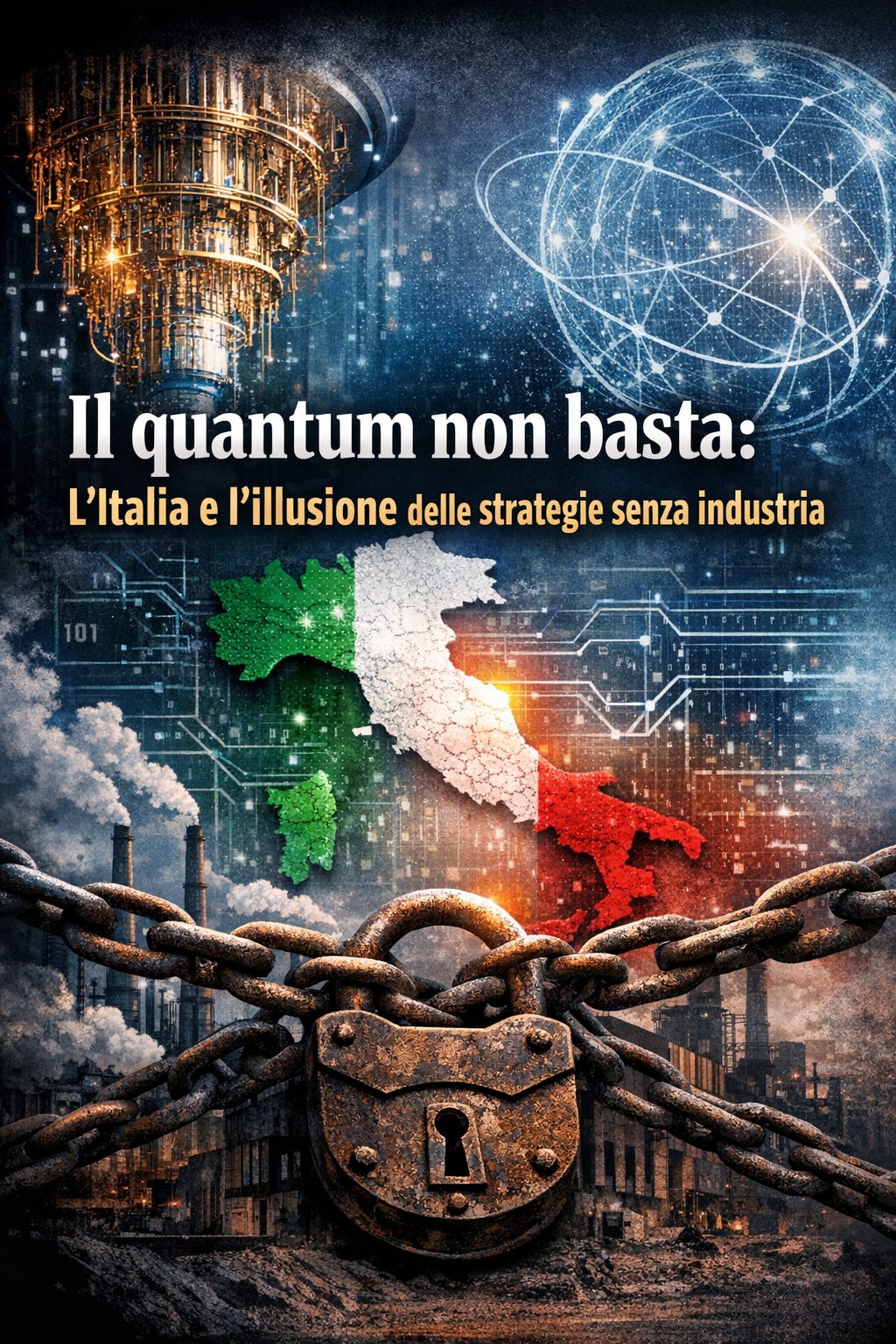
Il quantum non basta: l’Italia e l’illusione delle strategie senza industria
Risposta all’intervento di Gabriele Ferrieri * Presidente Angi
Risposta all’intervento di Gabriele Ferrieri * Presidente Angi
Link all’articolo di ‘La Repubblica’
di Luigi Ricci - 5 febbraio 2026
Nell’intervento su La Repubblica, Gabriele Ferrieri definisce le tecnologie quantistiche come la nuova infrastruttura critica del secolo, celebrando una strategia nazionale finalmente capace di unire politica, industria e ricerca. È una tesi condivisibile nelle premesse, ma che rischia di ignorare il vero nodo del problema: l’Italia non soffre di un deficit di intelligenza, ma di un deficit di potenza industriale.
La domanda che dobbiamo porci non è se l’Italia debba “esserci”, ma se saprà trasformare i 228 milioni del MUR e i nuovi poli tecnologici in potere economico reale. La storia recente suggerisce prudenza: in Italia, troppo spesso, la politica industriale viene scambiata per semplice finanziamento alla ricerca.
1. Il paradosso della ricerca senza ricaduta
L’Italia eccelle nella generazione di sapere, ma fallisce sistematicamente nella sua trasformazione in leadership di mercato. La filiera che porta dal laboratorio al mercato globale, ricerca, brevetto, startup, scale-up, industria, nel nostro Paese si interrompe quasi sempre a metà.
Senza una catena del valore capace di trattenere il talento, il rischio è che i fondi pubblici diventino una forma di sussidio indiretto per i giganti stranieri. Finanziamo la formazione di menti brillanti a Napoli o Cosenza per poi vederle assunte da multinazionali che integreranno quelle scoperte in prodotti venduti altrove. Non è un successo della ricerca; è una sovvenzione alla competitività altrui.
2. Lo Stato come “Primo Cliente”, non solo come finanziatore
Ogni rivoluzione tecnologica, dal GPS a Internet, ha avuto un acquirente iniziale disposto a rischiare: lo Stato. In Italia parliamo di “Stato stratega”, ma ci serve uno “Stato Cliente”.
L’ecosistema non nasce con l’annuncio di un polo, ma con il primo ordine d’acquisto.
Chi sarà il cliente del quantum italiano? La Difesa? La Pubblica Amministrazione?
Senza un mercato interno garantito nelle fasi iniziali, le nostre startup “deep tech” rimarranno esperimenti di laboratorio, destinate a essere acquisite per pochi milioni non appena diventeranno promettenti.
3. La strategia dei “Colli di Bottiglia”
Inseguire Stati Uniti e Cina sul terreno del computer quantistico universale è una battaglia persa in partenza per asimmetria di capitali. La vera sovranità risiede nei colli di bottiglia: presidiare quei componenti critici senza i quali l’intera filiera si ferma.
È il modello Technoprobe: non producono i chip, ma dominano il testing mondiale. Se l’Italia vuole contare nel quantum, deve puntare su nicchie ad altissimo valore aggiunto:
Sensing avanzato e metrologia.
Fotonica e materiali per la crittografia post-quantistica.
Componentistica criogenica e hardware specializzato.
Controllare un passaggio obbligato della filiera garantisce una leva geopolitica superiore a quella di chi costruisce il prodotto finale.
4. Conclusioni: Industrializzare o declinare
Ridurre il quantum a una sfida accademica è un errore di prospettiva. Il quantum è geopolitica pura. Chi controllerà le infrastrutture di calcolo e crittografia del futuro detterà le regole della sicurezza economica globale.
L’entusiasmo per la Strategia Nazionale 2025 è giustificato solo se accompagnato da una spietata analisi della realtà: la storia industriale insegna che non vince chi scopre per primo, ma chi industrializza per primo. Senza capitale paziente, grandi imprese integrate e uno Stato che compri innovazione invece di limitarsi a inaugurare poli, il “balzo in avanti” resterà un’architettura di carta.
L’ambizione tecnologica di un Paese si misura sui fatturati e sui brevetti difesi, non sui tavoli tecnici.
ENGLISH VERSION
Quantum is Not Enough: Italy and the illusion of strategies without industry
A response to Gabriele Ferrieri’s op-ed
by Luigi Ricci
In his contribution to Repubblica, Gabriele Ferrieri defines quantum technologies as the “new critical infrastructure of the 21st century,” praising a national strategy that finally aligns politics, industry, and research. While his premise is undeniably sound, it risks overlooking the heart of the matter: Italy does not suffer from a deficit of intelligence, but from a deficit of industrial power.
The decisive question is not whether Italy should “be there,” but whether it can transform the 2021-2024 MUR investments and the new 2025 Strategy into real economic power. Recent history suggests caution: in Italy, industrial policy is too often mistaken for mere research funding.
1. The Paradox of Research Without Output
Italy excels in generating knowledge but systematically fails to translate it into industrial leadership. The value chain that leads from the laboratory to the global market, research, patenting, startup, scale-up, industry, is almost always interrupted halfway in our country.
Without a value chain capable of retaining talent, there is a risk that public funds will become an indirect subsidy for foreign giants. We fund the training of brilliant minds in Naples or Calabria only to see them hired by multinationals that will integrate those discoveries into products sold elsewhere. This is not a research success; it is a subsidy for someone else’s competitiveness.
2. The State as “First Customer,” Not Just Financer
Every technological revolution, from GPS to the Internet, has had an initial buyer willing to take the risk: the State. In Italy, we talk about the “Strategist State,” but what we truly need is a “Customer State.”
An ecosystem is not born with the announcement of a hub, but with the first purchase order.
Who will be the customer for Italian quantum technology? Defense? Public Administration?
Without a guaranteed domestic market in the early stages, our deep-tech startups will remain laboratory experiments, destined to be acquired for a pittance as soon as they show promise.
3. The “Bottleneck Strategy”
Chasing the United States and China in the race for a universal quantum computer is a losing battle due to the massive capital asymmetry. True sovereignty lies in bottlenecks: dominating those critical components without which the entire chain stops.
This is the Technoprobe model: they don’t manufacture chips, but they dominate global testing. If Italy wants to matter in the quantum realm, it must bet on high-value niches:
Advanced sensing and metrology.
Photonics and materials for post-quantum cryptography.
Cryogenic components and specialized hardware.
Controlling a mandatory gateway in the supply chain grants far more geopolitical leverage than merely assembling the final product.
4. Conclusion: Industrialize or Decline
Reducing quantum technology to an academic challenge is a failure of perspective. Quantum is pure geopolitics. Those who control the computational and cryptographic infrastructures of the future will dictate the rules of global economic security.
The enthusiasm for the 2025 National Strategy is justified only if accompanied by a cold analysis of reality: industrial history teaches us that victory doesn’t go to the first to discover, but to the first to industrialize. Without patient capital, large integrated firms, and a State that buys innovation instead of just inaugurating hubs, this “leap forward” will remain a paper architecture.
A country’s technological ambition is measured by revenue and defended patents, not by technical committees.


Commenti
Posta un commento