Quando il custode della sicurezza sceglie la poesia
Mrinank Sharma (Direttore della sicurezza di Anthropic) ha deciso di scendere da quel treno.
Di Luigi Ricci - 12/02/2026
C’è un momento, nei viaggi ad alta velocità, in cui il paesaggio smette di essere distinguibile. Gli alberi si fondono in una linea continua, le case diventano geometrie indistinte, l’orizzonte si riduce a una vibrazione. Quando si raggiunge quella soglia, restare a bordo non è più davvero una scelta: è una forma di obbedienza alla velocità stessa.
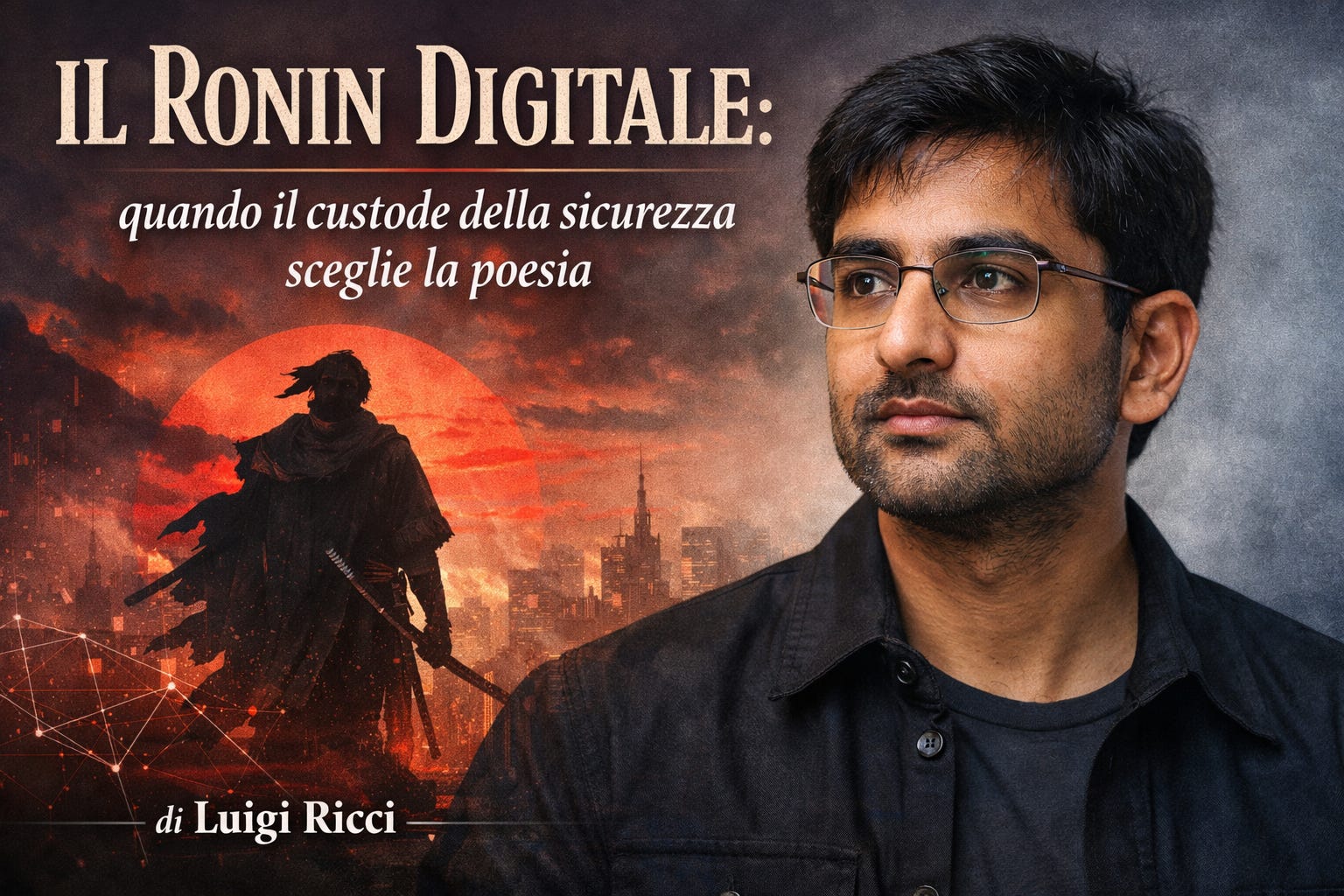
Tra le figure più autorevoli nel campo della sicurezza dell’intelligenza artificiale, le dimissioni di Mrinank Sharma da Anthropic sono del 9 febbraio 2026, l’azienda nata con l’ambizione di rappresentare un argine etico nella corsa globale all’AI, non assomigliano a un normale passaggio di carriera. Non evocano neppure l’idea di una divergenza tecnica. Somigliano piuttosto a un gesto di sottrazione, alla decisione di guadagnare distanza proprio mentre il sistema accelera.
In questa scelta c’è qualcosa di antico, quasi archetipico. È la postura del guerriero che depone le insegne non perché ha perso la battaglia, ma perché ha capito quale battaglia vale davvero la pena combattere. È, in senso pieno, l’emergere di un Ronin digitale.
Nella tradizione giapponese, il Ronin è il samurai rimasto senza padrone. Non è necessariamente un ribelle, né un disertore. È qualcuno che ha compreso come la fedeltà, quando diventa automatica, rischi di trasformarsi in una forma di cecità morale. La spada resta affilata, il codice resta intatto. Ma il giuramento, quello, va rinegoziato con qualcosa di più profondo del prestigio o dell’appartenenza.
È precisamente questa la geometria della scelta di Sharma.
Ha lasciato dopo aver contribuito a rafforzare in modo sostanziale l’architettura difensiva di Anthropic. Nel suo bilancio parla di tre direttrici decisive: sviluppare strumenti di benchmarking capaci di misurare davvero i limiti dei modelli; innalzare barriere contro il rischio che l’intelligenza artificiale possa abbassare la soglia d’accesso a minacce biologiche; trasformare la sicurezza da principio teorico a infrastruttura operativa.
Non sono risultati simbolici. Sono mura costruite pietra su pietra.
Eppure, a un certo punto, anche le fortezze meglio progettate rivelano una verità più sottile: la robustezza tecnica non garantisce una pari solidità culturale. Mentre l’architettura dei sistemi diventava più sofisticata, l’architettura dell’umano, dentro le organizzazioni e nello spazio pubblico, iniziava a mostrare crepe meno visibili ma infinitamente più profonde.
Sharma descrive questo scarto parlando di una “soglia della saggezza” che non stiamo riuscendo a oltrepassare. La nostra capacità di intervenire sul reale cresce con una rapidità quasi verticale; la nostra maturità collettiva, invece, sembra procedere con lentezza carsica. È una divergenza che nessun aggiornamento software può colmare, perché il problema non è nel codice: è nella cultura.
Nel suo messaggio emerge un passaggio destinato probabilmente a essere riletto negli anni: il rischio che proliferino “progetti pilota che ci rendono meno umani o distorcono la nostra umanità”.
Non è un avvertimento fantascientifico. È una diagnosi antropologica.
Per convivere con macchine sempre più performanti, stiamo iniziando ad assumere le loro posture: diventiamo più procedurali, più prevedibili, più orientati all’efficienza che alla comprensione. Gli incontri si accorciano perché le email sono più rapide. Le conversazioni si standardizzano perché i prompt funzionano meglio così. Il pensiero si linearizza perché gli algoritmi preferiscono le geometrie semplici.
Nel tentativo di proteggere l’umanità dalla macchina, stiamo lentamente addestrando l’umanità a funzionare come una macchina.
Il pericolo, allora, non è soltanto l’intelligenza artificiale che apprende troppo in fretta. È l’intelligenza umana che, quasi impercettibilmente, rinuncia alla propria complessità per restarle accanto.
Perché, dunque, scegliere la via del Ronin?
Perché Sharma sembra aver deciso di rinunciare a una posizione di influenza nel cuore dell’industria per praticare ciò che definisce un “discorso coraggioso”: riconoscere alla verità poetica lo stesso peso della verità scientifica. Non è un dettaglio ornamentale. È un cambio di asse epistemologico.
Nel suo congedo compaiono Rilke, il Dharma e infine William Stafford con la poesia The Way It Is. Stafford parla di un filo che si tiene in mano mentre tutto intorno cambia, brucia o invecchia. Quel filo è l’integrità. Finché non lo si lascia, scrive il poeta, è ancora possibile trovare la strada.
A volte, per non lasciarlo, bisogna uscire dalle mura.
La vicenda di Sharma non appare allora come una parentesi individuale, ma come il sintomo di una tensione più ampia che attraversa l’intero ecosistema tecnologico. Se perfino in un’organizzazione nata per mettere la sicurezza al centro le pressioni esterne possono spingere a “mettere da parte ciò che conta di più”, diventa difficile continuare a pensare alla sicurezza dell’AI come a un problema esclusivamente ingegneristico.
Sempre più chiaramente, si sta rivelando per ciò che è: un problema di civiltà.
Le infrastrutture possono essere rese resilienti, i modelli allineati, i protocolli raffinati. Ma nessun sistema tecnico può compensare una fragilità morale. Quando i custodi iniziano a uscire dalle mure, la domanda smette di essere quanto siano sicuri i sistemi che abbiamo costruito. Diventa un’altra, molto più radicale: quanto è stabile la visione dell’uomo che li sta costruendo?
Questa tensione, tra l’ingegneria della sicurezza e l’erosione delle certezze antropologiche, è al centro del mio prossimo saggio Vaticano Zero Day (Lindau, 1° maggio 2026), dove esploro come le grandi istituzioni della stabilità culturale affrontino la convergenza tra guerra ibrida e vulnerabilità sistemiche nell’era algoritmica.
Il Ronin digitale non è un’eccezione. È l’anticipazione di una figura destinata a moltiplicarsi.
Non abbandona il sistema per distruggerlo. Se ne allontana per custodire qualcosa che il sistema, nella sua corsa, rischia di non vedere più. Non denuncia. Non accusa. Semplicemente si sottrae, sapendo che a volte la distanza è l’unica forma di lucidità ancora praticabile. Ci ricorda che la vera soglia critica non sarà il giorno in cui le macchine penseranno come noi. Sarà il giorno in cui accetteremo, senza quasi accorgercene, di pensare come loro.
English version
The Digital Ronin: When the guardian of safety chooses poetry
By Luigi Ricci
There is a moment, in high-speed travel, when the landscape stops being distinguishable. Trees merge into a continuous line, houses become indistinct geometries, the horizon reduces to a vibration. When you reach that threshold, staying aboard is no longer really a choice: it becomes a form of obedience to speed itself.
Mrinank Sharma has decided to get off that train.
Among the most authoritative figures in the field of artificial intelligence safety, his resignation from Anthropic, the company born with the ambition to represent an ethical bulwark in the global AI race, does not resemble a normal career move. It doesn’t even evoke the idea of a technical disagreement. It resembles rather an act of subtraction, the decision to gain distance precisely while the system accelerates.
There is something ancient in this choice, almost archetypal. It is the posture of the warrior who lays down his insignia not because he has lost the battle, but because he has understood which battle is truly worth fighting. It is, in full sense, the emergence of a digital Ronin.
In Japanese tradition, the Ronin is the samurai left without a master. He is not necessarily a rebel, nor a deserter. He is someone who has understood how loyalty, when it becomes automatic, risks transforming into a form of moral blindness. The sword remains sharp, the code remains intact. But the oath, that one, must be renegotiated with something deeper than prestige or belonging.
This is precisely the geometry of Sharma’s choice.
He left after having substantially contributed to strengthening Anthropic’s defensive architecture. In his account, he speaks of three decisive directions: developing benchmarking tools capable of truly measuring model limits; raising barriers against the risk that artificial intelligence might lower the threshold of access to biological threats; transforming safety from a theoretical principle to operational infrastructure.
These are not symbolic results. They are walls built stone by stone.
Yet, at a certain point, even the best-designed fortresses reveal a subtler truth: technical robustness does not guarantee equal cultural solidity. While the architecture of systems became more sophisticated, the architecture of the human, within organizations and in public space, began to show less visible but infinitely deeper cracks.
Sharma describes this gap by speaking of a “wisdom threshold” that we are failing to cross. Our capacity to intervene in reality grows with almost vertical rapidity; our collective maturity, instead, seems to proceed with karstic slowness. It is a divergence that no software update can bridge, because the problem is not in the code: it is in the culture.
In his message emerges a passage likely to be reread for years: the risk of proliferating “pilot projects that make us less human or distort our humanity.”
This is not a science fiction warning. It is an anthropological diagnosis.
To coexist with increasingly performant machines, we are beginning to assume their postures: we become more procedural, more predictable, more oriented toward efficiency than understanding. Meetings get shorter because emails are faster. Conversations standardize because prompts work better that way. Thinking linearizes because algorithms prefer simple geometries.
In attempting to protect humanity from the machine, we are slowly training humanity to function like a machine.
The danger, then, is not only artificial intelligence learning too quickly. It is human intelligence that, almost imperceptibly, renounces its own complexity to stay alongside it.
Why, then, choose the path of the Ronin?
Because Sharma seems to have decided to renounce a position of influence at the heart of the industry to practice what he defines as “courageous speech”: recognizing poetic truth as having the same weight as scientific truth. This is not an ornamental detail. It is an epistemological axis shift.
In his farewell appear Rilke, the Dharma, and finally William Stafford with the poem The Way It Is. Stafford speaks of a thread you hold in your hand while everything around changes, burns, or ages. That thread is integrity. As long as you don’t let go of it, the poet writes, it is still possible to find the way.
Sometimes, to not let go of it, you must leave the walls.
Sharma’s story then appears not as an individual parenthesis, but as the symptom of a broader tension crossing the entire technological ecosystem. If even in an organization born to put safety at the center, external pressures can push to “set aside what matters most,” it becomes difficult to continue thinking of AI safety as an exclusively engineering problem.
More and more clearly, it is revealing itself for what it is: a problem of civilization.
Infrastructures can be made resilient, models aligned, protocols refined. But no technical system can compensate for moral fragility. When the guardians begin to leave the walls, the question stops being how safe the systems we have built are. It becomes another, much more radical one: how stable is the vision of humanity that is building them?
This tension, between the engineering of safety and the erosion of anthropological certainties, is at the center of my forthcoming essay Vatican Zero Day (Lindau, May 1, 2026), where I explore how the great institutions of cultural stability confront the convergence between hybrid warfare and systemic vulnerabilities in the algorithmic age.
The digital Ronin is not an exception. It is the anticipation of a figure destined to multiply.
He does not abandon the system to destroy it. He distances himself to preserve something that the system, in its rush, risks no longer seeing. He does not denounce. He does not accuse. He simply withdraws, knowing that sometimes distance is the only form of lucidity still practicable.
He reminds us that the true critical threshold will not be the day when machines think like us.
It will be the day when we accept, almost without noticing, to think like them.


Commenti
Posta un commento