12 marzo 2034, ore 06:00: il romanzo che racconta il 2026
La profondità della tana del bianconiglio: Benvenuti nell'era del collasso cinetico-digitale
Di Luigi Ricci – 18 marzo 2026
Il modo migliore per contattarmi è via email all’indirizzo luigiricci@hotmail.com.
C’è una gerarchia epistemica non scritta negli ambienti analitici: il dato quantitativo è segnale, la narrativa è rumore decorativo. Si tollera la letteratura come hobby del fine settimana, si cita il cinema come metafora occasionale, ma quando si tratta di capire cosa sta succedendo nel mondo si torna ai report, ai dataset, alle serie storiche.
È una gerarchia sbagliata. O meglio: incompleta. E l’incompletezza in analisi strategica non è un dettaglio, è un errore operativo.
In Vaticano Zero Day attingo a piene mani dalla letteratura e dalla cinematografia. Non come ornamento. Come fonte. I grandi narratori sono analisti di sistemi complessi che usano un formato diverso: il dato quantitativo misura, la narrativa comprende. In certi domini, quelli dove i dati sono classificati, dove le istituzioni non parlano, dove i processi sono opachi per definizione, la narrativa anticipa il dato di anni. A volte di decenni.
CONTIENE SPOILER
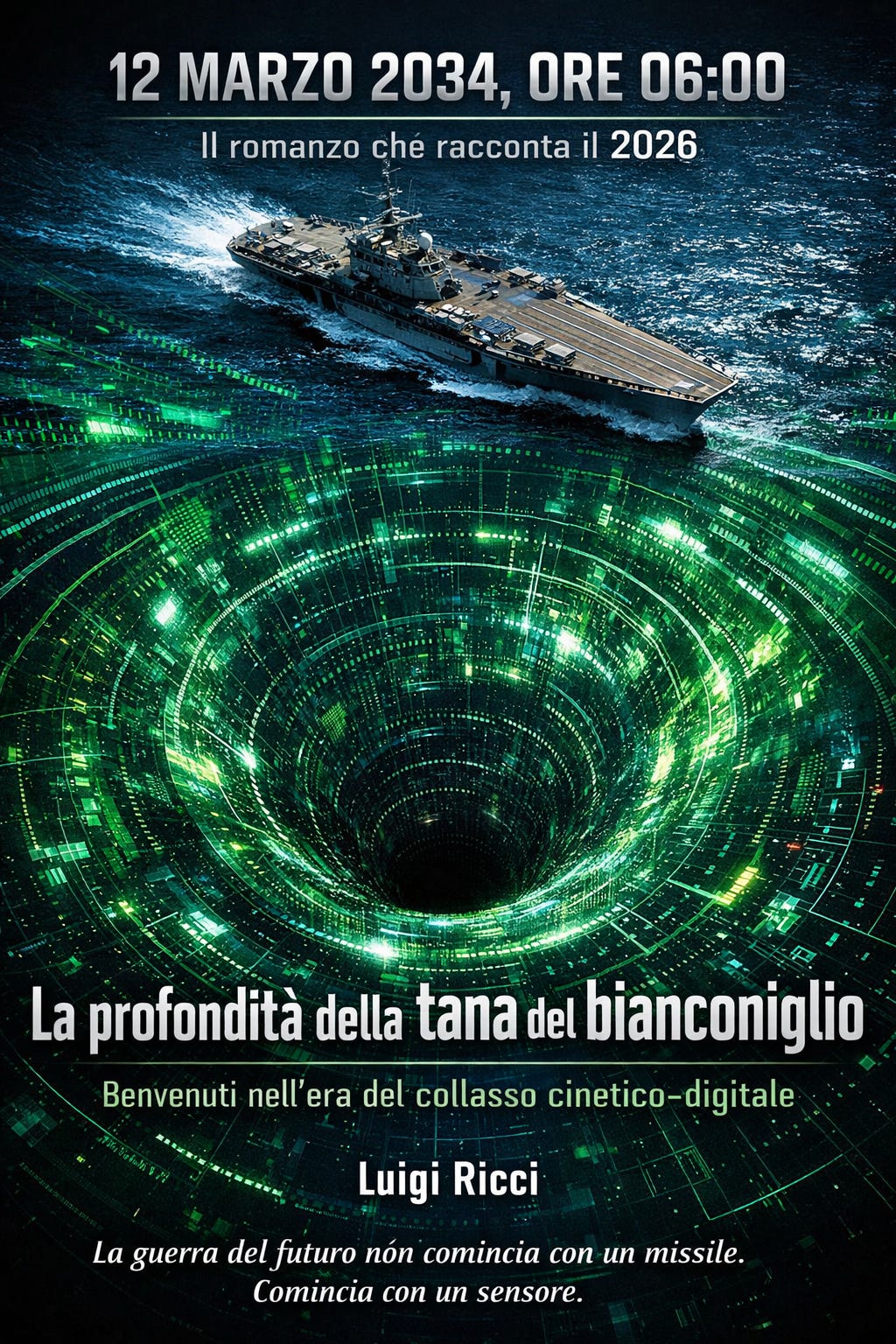
2034: A Novel of the Next World War di Elliot Ackerman e dell’Ammiraglio James Stavridis è il caso più recente e più clamoroso. Pubblicato nel marzo 2021, racconta una guerra tra Stati Uniti e Cina che comincia con un attacco SCADA, passa per un F-35 dirottato dagli iraniani con chiavi digitali cinesi, e arriva, attraverso una sequenza di escalation che nessuno riesce a fermare, alle prime bombe nucleari tattiche usate in combattimento dopo Hiroshima e Nagasaki. Non su basi militari remote. Su città.
L’anno in cui è ambientato è il 2034. Oggi è il 18 marzo 2026. Il romanzo ha smesso di parlare del futuro.
12 marzo 2034, ore 0600
Il Commodoro Sarah Hunt è sul ponte dell’USS John Paul Jones, nel Mar Cinese Meridionale. La mattina è piatta, il mare anche. I sensori rilevano un peschereccio senza bandiera in apparente difficoltà. Procedura standard: si avvicina, si verifica, si assiste.
È una trappola.
Nello stesso momento, il Maggiore Chris “Wedge” Mitchell, quarta generazione di aviatori americani, sta testando una nuova tecnologia stealth sorvolando lo Stretto di Hormuz con un F-35E Lightning. I sistemi di bordo rispondono regolarmente. Poi smettono di rispondere a lui.
Entro la fine della giornata, Wedge sarà prigioniero iraniano. La nave di Hunt giacerà sul fondo dell’oceano. Trentasette unità navali americane saranno state affondate. La Casa Bianca avvolta in un blackout orchestrato da Pechino. La fiducia americana nella propria supremazia militare, costruita in trent’anni di guerra unipolare, a brandelli.
Poi, molto più tardi, arriveranno le bombe.
Quello che avete appena letto non è un dispaccio operativo. È l’incipit di un romanzo pubblicato nel marzo 2021. L’anno in cui è ambientato è il 2034.
Chi ha scritto questo manuale
2034 non è fantasia geopolitica. È un documento di intelligence in forma narrativa.
Elliot Ackerman: otto anni nei Marines e nelle forze speciali, cinque tour di combattimento tra Iraq e Afghanistan, Silver Star, Bronze Star al valore, Purple Heart. James Stavridis: ammiraglio a quattro stelle, Comandante Supremo Alleato in Europa, SACEUR, per decenni ai vertici dell’intelligence e della pianificazione strategica NATO.
Quando scrivono che un F-35 può essere dirottato via intrusione informatica, non lo stanno immaginando. Lo sanno. Quando scrivono che la Cina può spegnere i sistemi di una portaerei americana nel Pacifico, stanno descrivendo una direzione di sviluppo vista nei briefing classificati.
Hanno scritto un romanzo perché i white paper non li legge nessuno. E perché, come Childers un secolo prima, sapevano che la narrativa è l’unico vettore che arriva prima dei fatti e viene ricordato dopo.
La guerra comincia con un sensore
Il peschereccio senza bandiera che Hunt intercetta è un nodo di una rete di sorveglianza che mappa in tempo reale i movimenti della flotta americana. Quando Hunt decide di avvicinarsi ha già perso, non perché abbia fatto la scelta sbagliata, ma perché la scelta era stata programmata per lei.
L’USS John Paul Jones non viene abbattuto: viene spento dall’interno, con la precisione di chi ha studiato ogni layer del suo sistema nervoso per anni, in silenzio, da remoto. È Stuxnet applicato alla proiezione di potenza navale.
Questa non è fantascienza. Nel 2015 Industroyer spense la luce a 230.000 ucraini in pieno inverno. Nel 2021 DarkSide paralizzò Colonial Pipeline per sei giorni. Nel 2024 CISA, NSA e FBI confermarono che Volt Typhoon, gruppo APT dell’Esercito Popolare di Liberazione, aveva mantenuto accesso persistente nelle infrastrutture critiche americane per almeno cinque anni, pre-posizionandosi in comunicazioni, energia, trasporti, reti idriche.
Il direttore dell’FBI Christopher Wray non usò metafore. Chiamò quella campagna la minaccia definitiva della nostra generazione.
Ackerman e Stavridis avevano scritto esattamente questo tre anni prima.
La trappola del dito cinese
La struttura del romanzo, quello che i due autori chiamano Chinese finger trap, è ingegneria strategica mascherata da thriller. La Cina non vuole la guerra aperta. Vuole la crisi controllata: disattivare il sistema nervoso digitale americano nel Pacifico abbastanza a lungo da ridisegnare i rapporti di forza, poi offrire una via d’uscita che Washington non possa rifiutare senza perdere la faccia definitivamente.
L’Iran è la variabile proxy: non un alleato ideologico, ma uno strumento operativo. Intercetta l’F-35 di Wedge perché Pechino gli ha fornito le chiavi digitali. Non serve sparare. Basta mandare il segnale giusto e il caccia più avanzato del mondo atterra docilmente su suolo nemico.
Il romanzo ipotizza che la vulnerabilità dell’F-35 venga dalla superiorità informatica iraniana, abilitata da Pechino. La realtà del 2025-2026 ha invertito il verso: sono gli F-35I israeliani ad aver penetrato lo spazio aereo iraniano con sostanziale impunità, prima nella Guerra dei Dodici Giorni del giugno 2025, poi nella campagna in corso. L’Iran non ha dimostrato la capacità di rilevare il caccia in modo affidabile, figuriamoci di dirottarlo digitalmente. Il vettore è rovesciato.
Questo non smentisce il romanzo. Lo aggiorna: la vulnerabilità non era nell’F-35, era nell’Iran.
C’è un dettaglio tecnico che il romanzo non poteva vedere: dal 2021 l’F-35 ha ricevuto il Tech Refresh 3, un aggiornamento che ha riscritto in profondità l’architettura software del caccia. I dati di progettazione compromessi dagli hacker cinesi nel 2007 descrivevano in parte un aereo che non esiste più nelle stesse forme. Il grano raccolto vent’anni fa descrive un campo che è stato arato e riseminato. Ma ogni riscrittura è anche una nuova superficie di attacco. I mietitori pazienti non perdono il sonno: archiviano il vecchio raccolto e aprono un nuovo campo.
I mietitori del futuro
Wedge Mitchell non viene abbattuto. Viene catturato, insieme al suo aereo, con tutti i suoi segreti tecnologici intatti. L’F-35E è atterrato su suolo nemico con i motori ancora caldi. Ogni chiave crittografica, ogni parametro stealth, ogni protocollo di comunicazione aspetta che qualcuno abbia il tempo di aprirlo. Il tempo, nella guerra ibrida, non è un vincolo. È una risorsa.
Questo è Harvest Now, Decrypt Later: raccogli adesso, decrittografa dopo. Le comunicazioni cifrate oggi inviolabili vengono intercettate e archiviate sistematicamente in attesa che un computer quantistico sufficientemente potente le renda leggibili in tempo reale. Il NIST americano ha pubblicato i primi standard di crittografia post-quantistica nell’estate del 2024, un’ammissione implicita che la finestra si sta chiudendo più velocemente del previsto.
La logica non si ferma al materiale militare. Si applica a ogni comunicazione cifrata e trasmessa nell’ultimo decennio: archivi diplomatici, corrispondenza istituzionale riservata, documentazione di intelligence, database di organizzazioni che si ritenevano al sicuro perché non erano né eserciti né banche, dottrinali, strategici, pastorali, personali. Ogni istituzione che custodisce segreti di lungo periodo ha già subito la mietitura. Stiamo solo aspettando che qualcuno apra il granaio.
I mietitori non hanno fretta. Sono già passati.
2034: quando il mulino si sveglia
C’è un salto che il romanzo lascia implicito ma che chiunque abbia familiarità con la roadmap del quantum computing legge tra le righe. Nel 2026 i battaglioni SCADA cinesi operano nella logica classica dell’intrusione persistente: entrano, aspettano, colpiscono al momento scelto. Devastante. Ma ancora dentro i limiti di ciò che può essere previsto e contrastato.
Nel 2034 quella logica è obsoleta. Il quantum computing non cerca la porta aperta, dissolve il concetto stesso di porta chiusa. Ogni sistema protetto dagli standard crittografici del 2026 è, nel 2034, un testo in chiaro leggibile in tempo reale. I battaglioni SCADA non devono più pre-posizionarsi per anni nelle infrastrutture nemiche: leggono i protocolli di comando e controllo della flotta avversaria mentre vengono trasmessi. Vedono le contromisure nel momento in cui vengono pianificate.
L’USS John Paul Jones non viene spento perché qualcuno ha studiato il suo sistema nervoso in silenzio per anni. Viene spento perché qualcuno sta leggendo ogni segnale che trasmette.
La Chinese finger trap nel 2034 non è solo ingegneria strategica. È onniscienza operativa temporanea. Ed è esattamente per questo che il NIST ha pubblicato i primi standard post-quantistici nell’estate del 2024 con una urgenza che i comunicati ufficiali cercavano di non mostrare: la finestra non si sta aprendo. Si sta chiudendo.
Il mulino si è svegliato. Non sappiamo ancora chi ha il grano.
Lin Bao e la tragedia dello specchio
Il personaggio più riuscito del romanzo non è americano. È l’Ammiraglio Lin Bao, attaché militare cinese, architetto silenzioso della crisi: metà americano, laureato al Naval War College di Newport, profondamente innamorato degli Stati Uniti. Un uomo che conosce intimamente ciò che si appresta a distruggere.
Ackerman lo costruisce sul modello di Yamamoto: il nemico che conosce il proprio avversario meglio di quanto l’avversario conosca sé stesso. Lin Bao sa che Washington risponderà con escalation convenzionale perché non conosce altra grammatica. Sa che il Congresso si paralizzerà nelle audizioni mentre le portaerei affondano.
Paga questa lucidità con la vita. Quando la crisi degenera oltre i suoi calcoli, Pechino ha bisogno di un capro espiatorio. Lin Bao era il candidato perfetto, troppo americano per essere pienamente cinese, troppo cinese per sopravvivere all’errore.
I suoi architetti più sofisticati della guerra ibrida sono quasi sempre persone che hanno frequentato il nemico abbastanza a lungo da capirne i punti ciechi. Non si tratta di odio. Si tratta di conoscenza applicata in senso inverso.
Lin Bao aveva letto Mearsheimer. I suoi avversari americani citavano Sun Tzu.
Il gradino che nessuno vuole nominare
C’è una domanda che 2034 pone con una brutalità che nessun white paper si permetterebbe: e se la guerra ibrida non bastasse? E se l’escalation sfuggisse di mano a tutti, incluso a chi l’aveva progettata?
Le prime bombe nucleari tattiche vengono usate in combattimento dopo ottant’anni di deterrenza. Non su basi militari remote. Su città. Zhanjiang viene cancellata da un ordigno americano. Galveston e San Diego vengono colpite in risposta. Trenta milioni di morti. I numeri pesano come piombo perché il lettore sa che ogni scelta che ha portato fin lì sembrava, presa singolarmente, razionale.
Nessuno decide di distruggere una città. Ognuno risponde, reagisce, ricalibra. I gradini intermedi si esauriscono uno per uno: le flotte sono già spente, le infrastrutture offline, l’attribuzione ancora contestata, per progetto, nella guerra ibrida l’attribuzione è sempre contestata, il tempo consumato. A quel punto il gradino nucleare non è più l’impensabile. È il penultimo.
La deterrenza nucleare si inceppa esattamente nel momento in cui la guerra ibrida ha già eroso ogni altra opzione. La sequenza non porta all’Armageddon per follia. Lo porta per esaurimento delle alternative.
Oggi, al giorno 20 della guerra in Iran, recuperare l’uranio altamente arricchito iraniano ritenuto sotterraneo richiederebbe un numero significativo di truppe di terra americane. Il gradino finale del romanzo non è più narrativo. È operativo.
Il romanzo finisce con gli Accordi di Nuova Delhi: è l’India, rimasta deliberatamente fuori dal conflitto, avendo coltivato un’equidistanza strategica che né Washington né Pechino avevano mai preso sul serio, a mediare la pace. Le Nazioni Unite si spostano a Mumbai. Il centro di gravità del mondo si è spostato mentre gli altri si distruggevano.
Ackerman e Stavridis non danno risposte. Hanno l’onestà intellettuale di non fingere di averle.
Il calendario ha smesso di non tornare
Volt Typhoon pre-posizionato dal 2019, confermato nel 2023. Dati F-35 compromessi nel 2007. Accordo Cina-Iran siglato nel marzo 2021, lo stesso mese del romanzo. Industroyer 2015. Colonial Pipeline 2021. Guerra dei Dodici Giorni giugno 2025. 28 febbraio 2026.
Tutto già accaduto. Tutto già scritto.
Un analista che non ha letto 2034 nel 2026 è nella stessa posizione del funzionario del Pentagono che nel 2005 non aveva letto Guerra senza limiti. Può ancora scrivere i suoi report. Può ancora partecipare ai briefing. Ma non capisce il frame dentro cui sta operando.
Torniamo al 12 marzo 2034, ore 0600. Il Commodoro Sarah Hunt è sul ponte dell’USS John Paul Jones. La mattina è piatta, il mare anche. I sensori rilevano un peschereccio senza bandiera in apparente difficoltà. Procedura standard.
Noi siamo Hunt. Siamo sul ponte, nel 2026. I sensori funzionano regolarmente. Il peschereccio è già in vista. La decisione di avvicinarsi era già stata programmata per noi.
La trappola era aperta. Mancava solo che qualcuno decidesse di chiuderla.
Qualcuno ha deciso. Era il 28 febbraio 2026.
English version
March 12, 2034, 06:00: The Novel That Describes 2026
The depth of the rabbit hole: Welcome to the era of kinetic-digital collapse
By Luigi Ricci – March 18, 2026
There is an unwritten epistemic hierarchy in analytical circles: quantitative data is signal, narrative is decorative noise. Literature is tolerated as a weekend hobby, cinema cited as an occasional metaphor, but when it comes to understanding what is actually happening in the world, one returns to reports, datasets, historical series.
It is a wrong hierarchy. Or rather: an incomplete one. And incompleteness in strategic analysis is not a detail, it is an operational error.
In Vaticano Zero Day I draw extensively from literature and cinema. Not as ornament. As source. Great storytellers are analysts of complex systems who use a different format: quantitative data measures, narrative understands. In certain domains, those where data is classified, where institutions do not speak, where processes are opaque by definition, narrative anticipates the data by years. Sometimes by decades.
CONTAINS SPOILERS
2034: A Novel of the Next World War by Elliot Ackerman and Admiral James Stavridis is the most recent and most striking case. Published in March 2021, it tells of a war between the United States and China that begins with a SCADA attack, passes through an F-35 hijacked by Iranians using Chinese digital keys, and arrives, through a sequence of escalations that no one can stop, at the first tactical nuclear bombs used in combat since Hiroshima and Nagasaki. Not on remote military bases. On cities.
The year in which it is set is 2034. Today is March 18, 2026. The novel has stopped talking about the future.
English Version
March 12, 2034, 0600
Commodore Sarah Hunt is on the bridge of the USS John Paul Jones, in the South China Sea. The morning is flat, the sea too. Sensors detect an unidentified fishing vessel in apparent distress. Standard procedure: approach, verify, assist.
It is a trap.
At the same moment, Major Chris “Wedge” Mitchell, fourth generation American aviator, is testing new stealth technology flying over the Strait of Hormuz in an F-35E Lightning. The onboard systems respond normally. Then they stop responding to him.
By the end of the day, Wedge will be an Iranian prisoner. Hunt’s ship will lie at the bottom of the ocean. Thirty-seven American naval units will have been sunk. The White House enveloped in a blackout orchestrated by Beijing. American confidence in its own military supremacy, built over thirty years of unipolar warfare, in tatters.
Then, much later, the bombs will come.
What you have just read is not an operational dispatch. It is the opening of a novel published in March 2021. The year in which it is set is 2034.
Who wrote this manual
2034 is not geopolitical fantasy. It is an intelligence document in narrative form.
Elliot Ackerman: eight years in the Marines and special forces, five combat tours between Iraq and Afghanistan, Silver Star, Bronze Star for valor, Purple Heart. James Stavridis: four-star admiral, Supreme Allied Commander Europe, SACEUR, for decades at the highest levels of NATO intelligence and strategic planning.
When they write that an F-35 can be hijacked via digital intrusion, they are not imagining it. They know it. When they write that China has developed the ability to shut down the systems of an American aircraft carrier in the Pacific, they are describing a direction of development they have seen in classified briefings.
They wrote a novel because no one reads white papers. And because, like Childers a century before, they knew that narrative is the only vector that arrives before the facts and is remembered after.
The war begins with a sensor
The unidentified fishing vessel that Hunt intercepts is a node in a surveillance network that maps American fleet movements in real time. When Hunt decides to approach she has already lost, not because she made the wrong choice, but because the choice had been programmed for her.
The USS John Paul Jones is not shot down: it is switched off from within, with the precision of someone who has studied every layer of that ship’s nervous system for years, in silence, remotely. It is Stuxnet applied to naval power projection.
This is not science fiction. In 2015, Industroyer shut off electricity for 230,000 Ukrainians in the middle of winter. In 2021, DarkSide paralyzed Colonial Pipeline for six days. In 2024, CISA, NSA, and FBI confirmed that Volt Typhoon, an APT group linked to the People’s Liberation Army, had maintained persistent access in American critical infrastructure for at least five years, pre-positioning itself in communications, energy, transportation, and water networks.
FBI Director Christopher Wray used no metaphors. He called that campaign the defining threat of our generation.
Ackerman and Stavridis had written exactly this three years earlier.
The Chinese Finger Trap
The novel’s structure, what the two authors call the Chinese finger trap, is strategic engineering disguised as a thriller. China does not want open war. It wants the controlled crisis: disable the American digital nervous system in the Pacific long enough to redraw the balance of power, then offer a way out that Washington cannot refuse without losing face permanently.
Iran is the proxy variable: not an ideological ally, but an operational instrument. It intercepts Wedge’s F-35 because Beijing has provided it the digital keys. No need to shoot. Just send the right signal at the right moment, and the world’s most advanced fighter lands docilely on enemy soil.
The novel assumes that the F-35’s vulnerability comes from Iranian cyber superiority, enabled by Beijing. The reality of 2025-2026 has inverted the vector: it is Israeli F-35Is that have penetrated Iranian airspace with substantial impunity, first in the Twelve-Day War of June 2025, then in the ongoing campaign. Iran has not demonstrated the ability to reliably detect the aircraft, let alone hijack it digitally. The vector is reversed.
This does not refute the novel. It updates it: the vulnerability was not in the F-35. It was in Iran.
There is a technical detail the novel could not foresee: since 2021, the F-35 has received Tech Refresh 3, an upgrade that fundamentally rewrote the aircraft’s software architecture. The design data compromised by Chinese hackers in 2007 partly described an aircraft that no longer exists in the same form. The grain harvested twenty years ago describes a field that has been plowed and reseeded. But every rewrite is also a new attack surface. Patient harvesters do not lose sleep over this: they archive the old harvest and open a new field.
The Harvesters of the Future
Wedge Mitchell is not shot down. He is captured, together with his aircraft, with all its technological secrets intact. The F-35E has landed on enemy soil with its engines still warm. Every cryptographic key, every stealth parameter, every communication protocol waits for someone to have the time to open it. Time, in hybrid warfare, is not a constraint. It is a resource.
This is Harvest Now, Decrypt Later: collect now, decrypt later. Communications that are unbreakable today are being systematically intercepted and archived in anticipation of the moment when a sufficiently powerful quantum computer will render them readable in real time. The American NIST published the first post-quantum cryptography standards in the summer of 2024, an implicit admission that the window is closing faster than expected.
The logic does not stop at military material. It applies to every communication encrypted and transmitted in the last decade: diplomatic archives, confidential institutional correspondence, intelligence documentation, databases of organizations that believed themselves safe because they were neither armies nor banks, doctrinal, strategic, pastoral, personal. Every institution that safeguards long-term secrets has already been harvested. We are only waiting for someone to open the granary.
The harvesters are not in a hurry. They have already passed.
2034: when the mill awakens
There is a leap the novel leaves implicit, but which anyone familiar with the quantum computing roadmap reads between the lines. In 2026, Chinese SCADA battalions operate within the classic logic of persistent intrusion: they enter, wait, strike at the chosen moment. Devastating. But still within the limits of what can be anticipated and countered.
By 2034, that logic is obsolete. Quantum computing does not look for the open door, it dissolves the very concept of a closed door. Every system protected by 2026 cryptographic standards is, in 2034, a plaintext readable in real time. SCADA battalions no longer need to pre-position themselves for years inside enemy infrastructure: they read the command and control protocols of the opposing fleet as they are transmitted. They see countermeasures in the moment they are planned.
The USS John Paul Jones is not switched off because someone studied its nervous system in silence for years. It is switched off because someone is reading every signal it transmits.
The Chinese finger trap in 2034 is not merely strategic engineering. It is temporary operational omniscience. And it is precisely for this reason that NIST published its first post-quantum standards in the summer of 2024 with an urgency that official communications tried not to show: the window is not opening. It is closing.
The mill has awakened. We do not yet know who holds the grain.
Lin Bao and the tragedy of the mirror
The novel’s most fully realized character is not American. He is Admiral Lin Bao, Chinese military attaché, silent architect of the crisis: half-American, a Naval War College of Newport graduate, deeply, in the most literal sense, in love with the United States. A man who intimately knows what he is about to destroy.
Ackerman builds him on the model of Yamamoto: the enemy who knows his adversary better than the adversary knows himself. Lin Bao knows that Washington will respond with conventional escalation because it knows no other grammar. He knows that Congress will paralyze itself in hearings while aircraft carriers sink.
He pays for this lucidity with his life. When the crisis degenerates beyond his calculations, Beijing needs a scapegoat. Lin Bao was the perfect candidate, too American to be fully Chinese, too Chinese to survive the error.
The most sophisticated architects of hybrid warfare are almost always people who have spent enough time with the enemy to understand its blind spots. It is not about hatred. It is about knowledge applied in reverse.
Lin Bao had read Mearsheimer. His American adversaries quoted Sun Tzu.
The step no one wants to name
There is a question 2034 poses with a brutality no white paper would permit itself: what if hybrid warfare were not enough? What if the escalation slipped out of everyone’s hands, including those who had designed it?
The first tactical nuclear bombs are used in combat after eighty years of deterrence. Not on remote military bases. On cities. Zhanjiang is erased by an American device. Galveston and San Diego are struck in response. Thirty million dead. The numbers weigh like lead because the reader knows that every choice that led there seemed, taken individually, rational.
No one decides to destroy a city. Everyone responds, reacts, recalibrates. The intermediate steps are exhausted one by one: the fleets are already dark, the infrastructure offline, attribution still contested, by design, in hybrid warfare attribution is always contested, time consumed. At that point the nuclear step is no longer the unthinkable. It is the penultimate.
Nuclear deterrence breaks down at precisely the moment when hybrid warfare has already eroded every other option. The sequence does not lead to Armageddon through madness. It leads there through exhaustion of alternatives.
Today, on day 20 of the war in Iran, recovering Iran’s highly enriched uranium believed to be underground would require a significant number of American ground troops. The novel’s final step is no longer narrative. It is operational.
The novel ends with the New Delhi Accords: it is India, which deliberately remained outside the conflict, having cultivated a strategic equidistance that neither Washington nor Beijing had ever taken seriously, that mediates the peace. The United Nations moves to Mumbai. The center of gravity of the world has shifted while the others destroyed each other.
Ackerman and Stavridis offer no answers. They have the intellectual honesty not to pretend they have them.
The calendar has stopped not adding up
Volt Typhoon pre-positioned from 2019, confirmed in 2023. F-35 design data compromised in 2007. China-Iran strategic cooperation agreement signed in March 2021, the same month as the novel. Industroyer 2015. Colonial Pipeline 2021. Twelve-Day War, June 2025. February 28, 2026.
All already happened. All already written.
An analyst who has not read 2034 in 2026 is in the same position as the Pentagon official who in 2005 had not read Unrestricted Warfare. He can still write his reports. He can still attend the briefings. But he does not understand the frame within which he is operating.
Let us return to March 12, 2034, 0600. Commodore Sarah Hunt is on the bridge of the USS John Paul Jones. The morning is flat, the sea too. Sensors detect an unidentified fishing vessel in apparent distress. Standard procedure.
We are Hunt. We are on the bridge, in 2026. The sensors are functioning normally. The fishing vessel is already in sight. The decision to approach had already been programmed for us.
The trap was open. It only needed someone to decide to close it.
Someone decided. It was February 28, 2026.


Commenti
Posta un commento