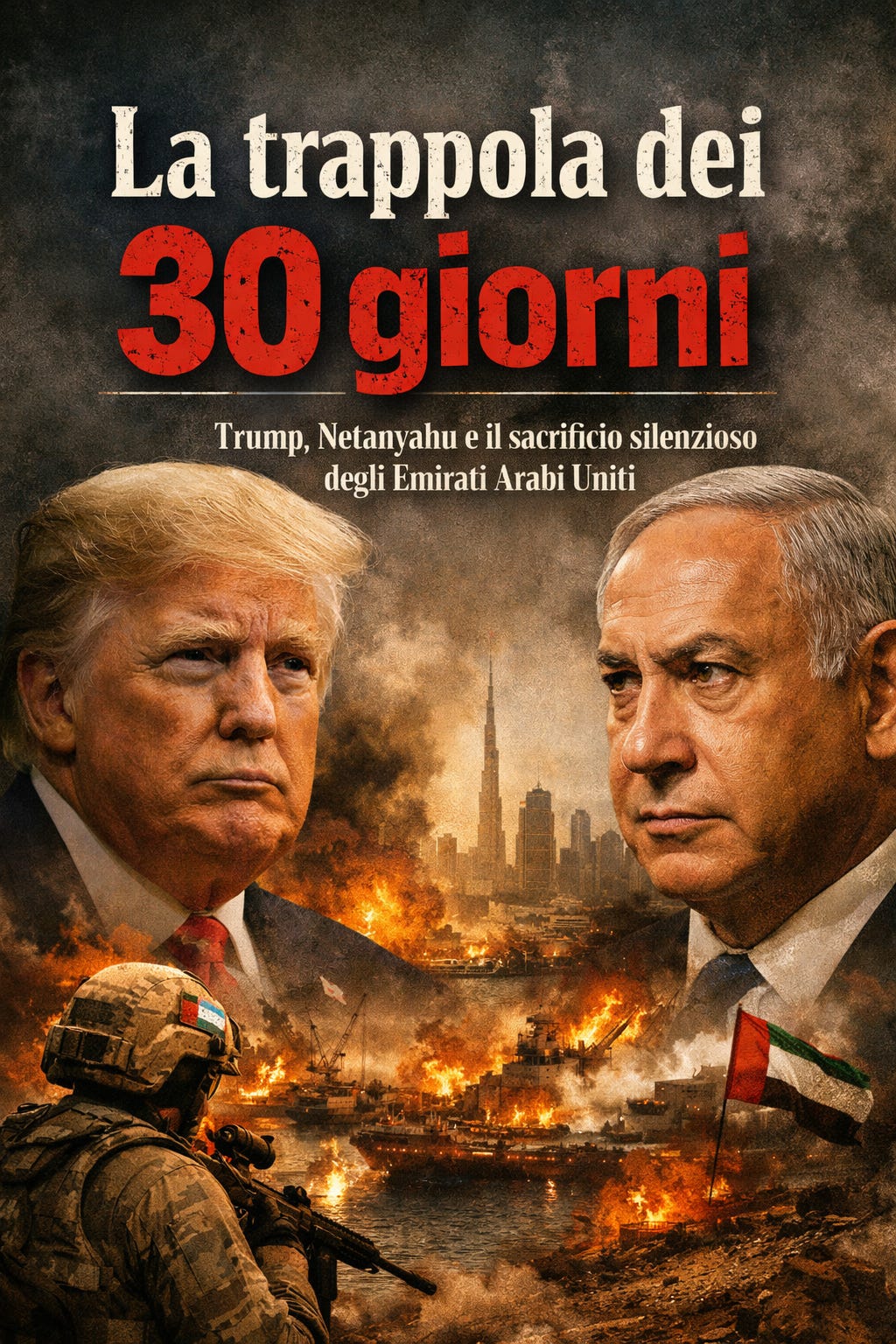
La trappola dei 30 giorni
Trump, Netanyahu e il sacrificio silenzioso degli Emirati Arabi Uniti
Siamo al sesto giorno dell’operazione “Epic Fury”. In quattro giorni: oltre 1.000 attacchi sull’Iran, quasi mille morti a Teheran, centinaia di miliardi bruciati dalle Borse europee, il porto di Jebel Ali colpito, il consolato americano di Dubai in fiamme, una portaerei costretta a ritirarsi verso l’Oceano Indiano. E Mojtaba Khamenei, figlio della Guida Suprema assassinata, già nominato successore dai Pasdaran mentre le bombe cadevano sulla sede dell’Assemblea degli Esperti a Qom.
Quando un leader politico mette una scadenza pubblica a una guerra, sta facendo una scommessa ad altissimo rischio: sta trasformando il tempo in un’arma contro sé stesso. Donald Trump ha fissato 4-5 settimane. “Epic Fury” deve chiudersi entro quel termine. Nel momento stesso in cui ha pronunciato quella frase, ha creato la propria condanna strategica.
Dal giorno 1 è partito un conto alla rovescia globale. Se al giorno 35 ci sono ancora missili iraniani nel Golfo, non serve propaganda: basta aritmetica politica. La base elettorale, i mercati, il Congresso, tutti potranno fare il conto. E il conto sarà impietoso.
Netanyahu ha un problema più profondo. Non ha un “dopo”. Ha presentato questa guerra come la soluzione definitiva alla minaccia esistenziale iraniana. Se l’Iran resiste, quella promessa collassa. E con essa l’unica giustificazione politica che ha retto l’architettura decisionale degli ultimi due anni. Trump rischia una sconfitta di performance. Netanyahu rischia una sconfitta di senso.
Sul piano militare, le campagne aeree intensive hanno un rendimento decrescente quasi matematico. Nei primi giorni si distruggono gli obiettivi ad alta priorità: centri di comando, radar, basi note, infrastrutture energetiche visibili. Il 60-70% dell’effetto militare si produce nella prima fase. Poi inizia la guerra contro le ombre, bersagli dispersi, mimetizzati, ridondanti. Ogni bomba aggiuntiva produce meno effetto operativo e più attrito politico. Dopo 30 giorni, continuare a bombardare significa ammettere che i primi 30 non sono bastati.
Sul piano economico, i mercati reagiscono sempre prima dei governi. Friedrich Merz, Emmanuel Macron, Keir Starmer e Giorgia Meloni non possono spiegare ai loro elettori una destabilizzazione energetica permanente in nome di una strategia americana a tempo determinato. Dopo 30 giorni senza risultato visibile, il costo diventa politicamente tossico.
Sul piano dell’ alleanze Nato le crepe sono già emerse, Madrid ha rifiutato di concedere le basi agli Stati Uniti. Londra ha già distinto tra difesa e offensiva. Parigi ha già parlato di diritto internazionale violato. Trump ha già attaccato verbalmente gli alleati europei. Dopo un mese senza vittoria fotografabile, l’isolamento americano non è più tattico ma strutturale: non più una divergenza di vedute, ma una frattura strategica difficilmente reversibile.
Sul piano interno americano, ogni conflitto ha una soglia invisibile di tolleranza. Se il capo degli Stati maggiori congiunti prevede già “ulteriori perdite”, il tempo diventa un moltiplicatore politico. Trenta giorni di bare che tornano a casa cambiano l’opinione pubblica più di cento conferenze stampa. La storia americana lo dimostra con brutalità: non è la guerra in sé a erodere un presidente, è la sua durata.
Qui risiede l’asimmetria fatale. Trump e Netanyahu marciano fianco a fianco, ma verso abissi opposti.
Trump vuole l’estetica della vittoria. Gli serve un fotogramma, un accordo, un “Deal”, un Vercingetorige da presentare come trofeo prima che le bare dei soldati americani inizino a pesare più dei voti. Per lui, la sopravvivenza è politica: un congelamento del programma nucleare iraniano può essere venduto come successo. Un pantano no.
Netanyahu vuole l’estetica dell’annientamento. Senza un cambio di regime, la sua intera narrazione ventennale crolla. Per lui un accordo è già una sconfitta, perché lascia intatta la struttura che ha definito come minaccia assoluta. Trump ha bisogno che la guerra finisca. Netanyahu ha bisogno che continui fino a un risultato irreversibile.
La bomba demografica iraniana fa più paura di quella nucleare: 92 milioni contro 10 milioni. Ogni anno in Iran nascono circa 1,1 milioni di bambini; Israele, pur registrando un boom di natalità, si ferma a 182 mila nati annui. I numeri sono destinati a parlare più forte delle bombe.
Questa divergenza non è secondaria: è la faglia sismica del conflitto. Trump ha già iniziato a costruire la sua via d’uscita, sussurrando ai media: “Forse ho forzato la mano io a Israele.” È il segnale del pre-abbandono. Quando Washington inizierà a parlare di negoziato, Gerusalemme parlerà di tradimento.
La nomina del figlio della Guida Suprema introduce un elemento paradossale che sfugge alla narrativa della guerra totale. Mojtaba Khamenei non è un martire: è un amministratore. Secondogenito di Ali, 55 anni, scelto dai Pasdaran, non dal clero, come figura di continuità, ha conti bancari a Londra, un impero immobiliare da oltre 100 milioni di sterline nel solo Regno Unito, e legami finanziari profondi nel sistema occidentale che Trump controlla con le sanzioni. Da più parti si definisce ormai quello iraniano come un regime mafioso travestito da teocrazia.
In geopolitica, l’interesse patrimoniale è più flessibile dell’ideologia. Un ayatollah duro e puro non si compra. Un uomo con qualcosa da perdere ha anche qualcosa da scambiare. La nomina di Mojtaba è, involontariamente, il miglior regalo che l’Iran potesse fare a Trump: un interlocutore negoziabile in abiti da Guida Suprema.
Se Trump è intelligente, e sulla sopravvivenza politica lo è, usa Mojtaba come la scialuppa di salvataggio. “Ho eliminato Khamenei, ho installato una nuova leadership, ho bloccato il nucleare.” Fine. Vittoria dichiarata. Sipario. Il tutto prima del giorno 30, prima che il tempo trasformi la performance in processione funebre.
C’è un attore in questa guerra che non ha scelto di combattere, eppure è il più colpito. Gli Emirati Arabi Uniti hanno subito, in questa prima settimana di guerra, più attacchi iraniani di quanti ne abbia subiti Israele. Ottocento colpi. Il porto di Jebel Ali, il più grande del Medio Oriente, danneggiato. Hotel, condomini residenziali, infrastrutture civili colpite. Tutto questo senza aver dichiarato guerra a nessuno.
La logica iraniana è di cristallina brutalità: “Se dal tuo territorio partono operazioni contro di noi, sei un obiettivo legittimo.” Dubai ospita basi americane. Quindi Dubai è cobelligerante. La colpa è di Washington, ma il conto lo pagano gli emiratini.
È la geometria classica del capro espiatorio geopolitico. Gli Emirati non sono una vittima casuale: sono la variabile di aggiustamento del conflitto. L’Iran li colpisce non per distruggerli, ma per usarli come leva negoziale. Ogni drone su Jebel Ali è un messaggio a Washington, un costo che Trump scarica sui propri alleati mentre vende vittoria ai propri elettori.
Abu Dhabi è intrappolata in una contraddizione strutturale che non ha soluzione elegante. Non può espellere le basi USA, perderebbe l’ombrello di sicurezza americano che la protegge dall’Iran da trent’anni. Non può restare neutrale, l’Iran non glielo permette. Non può attaccare l’Iran, si esporrebbe a una risposta devastante senza capacità militare sufficiente. Non può negoziare separatamente con Teheran, tradirebbe Washington in un momento di guerra aperta.
L’asimmetria economica è altrettanto letale. Per intercettare un drone iraniano Shahed che costa poche migliaia di dollari, gli Emirati devono usare missili Patriot che costano milioni ciascuno. L’Iran potrebbe disporre di decine di migliaia di questi droni. I paesi del Golfo rischiano di esaurire le proprie difese prima che l’Iran esaurisca le proprie munizioni. È una guerra di attrito asimmetrico, e l’asimmetria va nella direzione sbagliata.
L’unico ruolo che salva Abu Dhabi, sia la faccia che l’economia, è diventare il canale negoziale segreto tra Washington e Teheran. È il ruolo che l’Oman sta già giocando pubblicamente, invocando un cessate il fuoco immediato. È il ruolo che gli Emirati conoscono perfettamente: hub neutrale, intermediario credibile, ponte tra mondi che non si parlano. Ma per farlo, devono smettere di sembrare un satellite americano. E questa guerra ha reso quella distinzione quasi impossibile.
Al di là dei leader, delle portaerei, dei missili e dei droni, c’è una perdita più silenziosa che nessuna conferenza stampa commemora: l’erosione dell’ordine internazionale basato sul diritto.
Questa guerra è stata lanciata senza mandato ONU, senza dichiarazione formale, con intelligence usata come giustificazione preventiva, esattamente come Iraq 2003, con la differenza che allora ci vollero mesi di preparazione diplomatica e almeno la finzione di una coalizione. Stavolta bastava un colpo di intelligence e una mattina di sabato.
In merito a questa escalation, il Cardinale Pietro Parolin, Segretario di Stato della Santa Sede, ha espresso una ferma condanna della strategia della “guerra preventiva”, definendola un grave rischio capace di “incendiare il mondo”. Ha denunciato una preoccupante deriva in cui la “forza del diritto” è stata sostituita dal “diritto della forza”, portando a un indebolimento progressivo dei trattati e delle norme globali.
Se questa guerra viene “vinta” in 30 giorni, quella violazione diventa precedente legittimante: chiunque, in futuro, potrà citarla per fare lo stesso. Se viene persa o si trasforma in pantano, il danno è doppio: si è violato il diritto internazionale e si è dimostrato che la violazione non paga nemmeno militarmente. Vale la pena ricordarlo: anche la “missione speciale” russa in Ucraina pensava di prendere Kiev in pochi giorni. Dopo quattro anni, è finita nel pantano del Donbass.
Non è un caso che Papa Leone XIV abbia parlato di “voragine irreparabile”. Non è retorica morale, è consapevolezza storica. Il Vaticano conosce la storia lunga, quella che non si misura in cicli elettorali ma in generazioni. E sa che le guerre rapide e le guerre infinite producono entrambe cicatrici profonde: le prime creano precedenti, le seconde creano traumi. In entrambi i casi, il mondo che emerge è più fragile di quello che è entrato.
C’è un attore che non ha sparato un colpo, non ha rilasciato dichiarazioni militari, non ha mandato portaerei. Osserva, compra petrolio iraniano a forte sconto, rafforza la propria posizione come unica potenza in grado di parlare con tutti, e aspetta pazientemente che l’America si logori. Si chiama Cina.
Pechino ha già dimostrato di saper aspettare durante ogni conflitto mediorientale degli ultimi vent’anni, con rendimenti crescenti. L’Iran è il terzo fornitore di petrolio cinese. Una destabilizzazione irreversibile di Teheran non è nell’interesse di Pechino. Ma un’America impantanata in un nuovo Medio Oriente, mentre la Cina consolida la Via della Seta e la propria influenza in Asia, Africa e America Latina, questo è esattamente lo scenario che Pechino ha disegnato nei propri scenari strategici.
Gli Emirati lo sanno. Ed è per questo che Abu Dhabi, nel lungo periodo, potrebbe non scegliere Washington. Potrebbe scegliere la neutralità cinese. Questa guerra potrebbe accelerare quel riposizionamento di una generazione.
Forse, entro il giorno 30, il sipario calerà. Trump cercherà un’uscita mascherata da trionfo, un accordo di facciata che gli permetta di dire: “Ho riportato la pace, ho bloccato il nucleare, ho eliminato la minaccia.” Come già avvenne nella crisi dei 12 giorni del giugno 2025, quando Washington trovò la via d’uscita diplomatica e Israele si ritrovò solo davanti al risultato. In quel momento, Netanyahu si volterà e troverà il posto accanto a lui vuoto.
L’America, come sempre nella sua lunga e cinica storia mediorientale, si ritirerà verso le proprie coste, lasciando a chi resta l’onere di pagare i conti di una guerra che non ha risolto nulla, ma ha cambiato tutto. Iraq docet. L’Iran sarà ancora lì, più radicalizzato, più determinato, con un programma nucleare che ripartirà in clandestinità totale. Israele sarà ancora lì, con il fianco esposto e un’America che ha già iniziato a guardare altrove. Gli Emirati saranno ancora lì, con le macerie di un modello economico che pensavano fosse eterno.
English version
The thirty-day time trap
Trump, Netanyahu, and the silent sacrifice of the United Arab Emirates
In the gilded halls of Mar-a-Lago and the fortified bunkers of Tel Aviv, time has been treated as a submissive ally, a variable to be bent to the weight of political will. But history is not a real estate negotiation, nor a permanent electoral campaign. History has its own heartbeat. And today, that heartbeat marks the rhythm of a sentence: thirty days.
We are on the fifth day of Operation “Epic Fury”. In four days: over 1,000 strikes on Iran, nearly 900 dead in Tehran, 565 billion euros wiped from European stock markets, the port of Jebel Ali hit, the American consulate in Dubai in flames, an aircraft carrier forced to retreat toward the Indian Ocean. And Mojtaba Khamenei, son of the assassinated Supreme Leader, already appointed as successor by the Revolutionary Guards while bombs fell on the Assembly of Experts headquarters in Qom.
None of these numbers tells a story of victory. None of these events marks a surrender. What is emerging, with the cold precision of geopolitical arithmetic, is something more subtle and more dangerous: the structure of a conflict no one knows how to stop.
When a political leader sets a public deadline on a war, he is making an extremely high-risk wager: he is turning time into a weapon against himself. Donald Trump has fixed 4 to 5 weeks. “Epic Fury” must conclude within that timeframe. The moment he uttered those words, he created his own strategic death sentence.
From day one, a global countdown began. If on day 35 Iranian missiles are still flying over the Gulf, no propaganda is needed: political arithmetic will do the work. The electoral base, the markets, Congress, all will be able to do the math. And the reckoning will be merciless.
Netanyahu’s problem runs deeper. He has no “after”. He has presented this war as the definitive solution to the existential Iranian threat. If Iran holds out, that promise collapses. And with it, the only political justification that has sustained the decision-making architecture of the past two years. Trump risks a defeat of performance. Netanyahu risks a defeat of meaning.
And that meaning has already been compromised. The 12-day war had already revealed a crack that no victory narrative had fully managed to conceal: the Iron Dome, the very symbol of Israeli invulnerability, the impregnable fortress built over twenty years of technology and American billions, had exposed its vulnerabilities. It was not infallible. It could be saturated. It was enough to multiply the vectors, overload the interception systems, launch more projectiles than the system could shoot down in sequence. Iran had understood this, studied it, written it into its own military doctrine. That crack was never truly sealed. And today, under the sky of the fifth day of war, Iranian doctrine is exploiting it.
On the military level, intensive air campaigns have an almost mathematical law of diminishing returns. In the first days, high-priority targets are destroyed: command centers, radar systems, known bases, visible energy infrastructure. Sixty to seventy percent of the military effect is produced in the first phase. Then begins the war against shadows, dispersed, camouflaged, redundant targets. Every additional bomb produces less operational effect and more political friction. After 30 days, continuing to bomb means implicitly admitting that the first 30 days were not enough.
On the economic level, markets always react before governments. Five hundred billion euros in market capitalization burned in four days is not a statistic: it is an earthquake. Friedrich Merz, Emmanuel Macron, Keir Starmer and Giorgia Meloni cannot explain to their voters a permanent energy destabilization in the name of a time-limited American strategy. After 30 days without a visible result, the cost becomes politically toxic.
On the coalition level, the cracks have already appeared. Madrid refused to grant the United States access to its military bases. London has already drawn a line between defense and offense. Paris has already spoken of international law being violated. Trump has already verbally attacked European allies. After a month without a photogenic victory, American isolation is no longer tactical but structural, no longer a divergence of views, but a strategic fracture that will be very difficult to reverse.
On the American domestic level, every conflict has an invisible threshold of tolerance. If the Chairman of the Joint Chiefs of Staff is already warning of “further losses”, time becomes a political multiplier. Thirty days of coffins returning home change public opinion more than a hundred press conferences. American history demonstrates this with brutal clarity: it is not the war itself that erodes a president, it is its duration.
Here lies the fatal asymmetry. Trump and Netanyahu march side by side, but toward opposite abysses.
Trump wants the aesthetics of victory. He needs a photograph, a deal, a trophy, a Vercingetorix to present before the coffins of American soldiers start weighing more than votes. For him, survival is political: a freeze on Iran’s nuclear program can be sold as success. A quagmire cannot.
Netanyahu wants the aesthetics of annihilation. Without a regime change, his entire twenty-year narrative collapses. For him, any agreement is already a defeat, because it leaves intact the structure he has defined as an absolute threat. Trump needs the war to end. Netanyahu needs it to continue until an irreversible result is achieved. The Iranian demographic bomb is more frightening than the nuclear one: 92 million against 10 million. Every year in Iran approximately 1.1 million children are born; Israel, despite experiencing a birth rate boom, reaches only 182,000 births annually. The numbers are destined to speak louder than the bombs.
This divergence is not secondary: it is the seismic fault line of the conflict. Trump has already begun building his exit, whispering to the media: “Maybe I forced Israel’s hand.” It is the signal of pre-abandonment. When Washington begins to talk of negotiation, Jerusalem will talk of betrayal.
The appointment of the Supreme Leader’s son introduces a paradoxical element that escapes the narrative of total war. Mojtaba Khamenei is not a martyr: he is an administrator. Ali’s second son, 55 years old, chosen by the Revolutionary Guards, not the clergy, as a figure of continuity, he holds bank accounts in London, a real estate empire worth over 100 million pounds in the United Kingdom alone, and deep financial ties within the Western system that Trump controls through sanctions. From many quarters, the Iranian regime is now described as a mafia enterprise dressed in theocratic robes.
In geopolitics, patrimonial interest is more flexible than ideology. A hardline ayatollah cannot be bought. A man with something to lose also has something to trade. Mojtaba’s appointment is, involuntarily, the best gift Iran could have given Trump: a negotiable interlocutor wearing the robes of a Supreme Leader.
If Trump is intelligent, and on the question of political survival, he is, he uses Mojtaba as the lifeboat. “I eliminated Khamenei, I installed new leadership, I blocked the nuclear program.” Done. Victory declared. Curtain down. All of this before day 30, before time transforms the performance into a funeral procession.
There is one actor in this war who did not choose to fight, yet is the most heavily struck. The United Arab Emirates have suffered, in this first week of war, more Iranian attacks than Israel itself. Eight hundred strikes. The port of Jebel Ali, the largest in the Middle East, damaged. Hotels, residential buildings, civilian infrastructure hit. All of this without having declared war on anyone.
The Iranian logic is of crystalline brutality: “If operations against us are launched from your territory, you are a legitimate target.” Dubai hosts American bases. Therefore Dubai is a co-belligerent. The fault lies with Washington, but the bill is paid by the Emiratis.
This is the classic geometry of the geopolitical scapegoat. The Emirates are not a random victim, they are the adjustment variable of the conflict. Iran strikes them not to destroy them, but to use them as a negotiating lever. Every drone over Jebel Ali is a message to Washington, a cost that Trump offloads onto his own allies while selling victory to his own voters.
Abu Dhabi is caught in a structural contradiction that has no elegant solution. It cannot expel the American bases, it would lose the security umbrella that has protected it from Iran for thirty years. It cannot remain neutral, Iran will not allow it. It cannot attack Iran, it would expose itself to a devastating response without sufficient military capability. It cannot negotiate separately with Tehran, it would betray Washington in a moment of open war.
The economic asymmetry is equally lethal. To intercept an Iranian Shahed drone that costs a few thousand dollars, the Emirates must use Patriot missiles that cost millions each. Iran could possess tens of thousands of these drones. Gulf countries risk exhausting their defenses before Iran exhausts its munitions. It is a war of asymmetric attrition, and the asymmetry runs in the wrong direction.
The only role that saves Abu Dhabi, both face and economy, is to become the secret negotiating channel between Washington and Tehran. It is the role that Oman is already playing publicly, calling for an immediate ceasefire. It is the role the Emirates know perfectly: neutral hub, credible intermediary, bridge between worlds that do not speak to each other. But to play it, they must stop appearing as an American satellite. And this war has made that distinction almost impossible.
Beyond the leaders, the aircraft carriers, the missiles and the drones, there is a quieter loss that no press conference commemorates: the erosion of the international order based on law.
This war was launched without a UN mandate, without a formal declaration, with intelligence used as pre-packaged justification, exactly like Iraq in 2003, with the difference that back then it took months of diplomatic preparation and at least the fiction of a coalition. This time, all it took was one intelligence strike and a Saturday morning.
In response to this escalation, Cardinal Pietro Parolin, Secretary of State of the Holy See, issued a firm condemnation of the strategy of “preventive war”, describing it as a grave risk capable of “setting the world on fire”. He denounced a troubling drift in which the “rule of law” has been replaced by the “law of force”, leading to a progressive weakening of international treaties and norms.
If this war is “won” in 30 days, that violation becomes a legitimizing precedent: anyone, in the future, will be able to cite it to do the same. If it is lost or turns into a quagmire, the damage is double: international law has been violated, and the violation has been shown not to pay even militarily. It is worth remembering: Russia’s “special military operation” in Ukraine also expected to reach Kyiv in a few days. After four years, it became mired in the Donbas.
It is no coincidence that Pope Leo XIV spoke of an “irreparable abyss”. This is not moral rhetoric, it is historical awareness. The Vatican knows the long arc of history, the one measured not in electoral cycles but in generations. And it knows that rapid wars and endless wars both leave deep scars: the former create precedents, the latter create trauma. In both cases, the world that emerges is more fragile than the one that entered.
There is one actor that has not fired a shot, has not issued military statements, has not sent aircraft carriers. It watches, buys Iranian oil at a steep discount, strengthens its position as the only power capable of speaking with everyone, and waits patiently for America to exhaust itself. Its name is China.
Beijing has already demonstrated its ability to wait through every Middle Eastern conflict of the past twenty years, with increasing returns. Iran is China’s third largest oil supplier. An irreversible destabilization of Tehran is not in Beijing’s interest. But an America bogged down in a new Middle East, while China consolidates the Belt and Road and its influence across Asia, Africa and Latin America, this is precisely the scenario Beijing has drawn in its own strategic planning.
The Emirates know this. And it is for this reason that Abu Dhabi, in the long run, may not choose Washington. It may choose Chinese neutrality. This war could accelerate that generational repositioning.
Perhaps, before day 30, the curtain will fall. Trump will seek an exit disguised as triumph, a cosmetic agreement that allows him to say: “I restored peace, I blocked the nuclear program, I eliminated the threat.” As already happened during the 12-day crisis of June 2025, when Washington found the diplomatic exit and Israel found itself alone before the result. In that moment, Netanyahu will turn around and find the seat beside him empty.
America, as always in its long and cynical Middle Eastern history, will retreat toward its own shores, leaving those who remain with the burden of paying the bill for a war that resolved nothing, but changed everything. Iraq docet. Iran will still be there, more radicalized, more determined, with a nuclear program that will restart in total secrecy. Israel will still be there, its flank exposed and an America that has already begun to look elsewhere. The Emirates will still be there, amid the ruins of an economic model they thought was eternal.


Commenti
Posta un commento