Chi risponde? L'Europa senza sentinella sulla libertà religiosa

Perché l'UE ha bisogno di un'agenzia, non di un altro nome
(English version included)
Scrivendo
Vaticano Zero Day mi sono accorto di una cosa che, una volta vista, non si può
più smettere di vedere. A differenza di quanto avviene negli Stati Uniti, dove
esiste un organismo federale permanente come la U.S. Commission on
International Religious Freedom, l’Unione Europea non dispone di un meccanismo
strutturale, autonomo e vincolante di monitoraggio della persecuzione
religiosa, e in particolare di quella anti-cristiana. Le iniziative europee
restano episodiche, affidate a risoluzioni parlamentari prive di effetti
operativi o a dichiarazioni diplomatiche che non producono conseguenze
concrete.
Ancora più
rivelatrice è l’assenza di condizionalità sistemica. L’Unione negozia accordi
commerciali, energetici e strategici con Paesi in cui la persecuzione dei
cristiani è documentata e crescente, senza che tale persecuzione diventi mai un
vincolo reale. L’India può registrare un aumento esponenziale delle violenze
anti-cristiane mentre rafforza il partenariato strategico con Bruxelles. La
Cina può intensificare la repressione delle comunità cristiane non allineate
mentre l’Unione continua a trattare su commercio, tecnologia e clima. La
Nigeria può ignorare migliaia di cristiani uccisi ogni anno mentre l’Europa
coopera sul gas e sul contenimento dei flussi migratori.
Quando
scrivevo queste righe, l’assenza che descrivevo era ancora, in un certo senso,
un’assenza pulita: un vuoto istituzionale, misurabile, orfano di una figura che
nemmeno esisteva più sulla carta. Da allora qualcosa è cambiato, ma non nel
modo in cui ci si sarebbe aspettati. L’Europa ha finalmente rimesso un nome su
quella casella vuota. E proprio osservando come lo ha fatto, con quale
procedura, con quali risorse, con quale grado di serietà istituzionale, si
capisce che il problema non era soltanto l’assenza di una persona. Era, ed è,
l’assenza di un’architettura.
Per
capire cosa manca all’Europa, conviene partire da chi un’architettura ce l’ha
davvero.
Il
modello che l’Europa non ha
Nel 1998,
mentre in Europa si discuteva ancora se la libertà religiosa fosse materia da
trattato o da enciclica, il Congresso degli Stati Uniti approvava
l’International Religious Freedom Act e dava vita a un organismo che oggi,
quasi trent’anni dopo, resta senza equivalenti al mondo: la United States
Commission on International Religious Freedom.
Non un
ufficio diplomatico, non una task force temporanea, un’agenzia federale creata
per consigliare l’esecutivo e il Congresso su come promuovere la libertà
religiosa a livello internazionale. La stessa legge crea, in parallelo, una
seconda figura, l’Ambasciatore itinerante per la libertà religiosa
internazionale presso il Dipartimento di Stato.
Gli Stati
Uniti, in altre parole, non hanno un solo strumento su questo dossier, ne hanno
due, distinti e complementari: uno indipendente dal potere esecutivo, che
riferisce al Congresso, e uno dentro la diplomazia attiva, che negozia
direttamente con i governi esteri.
La
Commissione lavora con un metodo che ha fatto scuola: mappa le violazioni, le
classifica, le nomina. Il rapporto annuale, obbligatorio per legge, mette a
fuoco discriminazioni e persecuzioni in tutti i Paesi del mondo per produrre
raccomandazioni politiche destinate al presidente, al segretario di Stato e al
Congresso.
Il cuore
del meccanismo sono due liste: i CPC, Countries of Particular Concern, per chi
commette o tollera violazioni sistematiche, protratte e gravi, e la Special
Watch List, per chi è in traiettoria di peggioramento.
Nel
rapporto 2025 la fascia più grave include Afghanistan, Birmania, Cina, Eritrea,
India, Iran, Nigeria, Corea del Nord, Pakistan, Arabia Saudita, Tagikistan,
Turkmenistan e Vietnam. La designazione non è simbolica, aziona per legge un
ventaglio di risposte possibili, dalle sanzioni mirate alle condizionalità
diplomatiche, decise poi dal Dipartimento di Stato, ma su un procedimento che
la legge obbliga comunque ad attivare.
Ai numeri
dei Paesi, la Commissione affianca i nomi delle persone. La FoRB Victims List,
il database nominativo aggiornato ogni anno, nel 2025 conta oltre 2330 vittime
documentate, in crescita rispetto alle 2200 dell’anno precedente, riconducibili
a 28 diversi governi o organizzazioni non statali.
Tre Paesi,
Cina, Russia e Iran, sono responsabili del 73% dei casi. Il rapporto ha anche
messo a fuoco un fenomeno relativamente nuovo, la repressione transnazionale:
Russia, Cina, Bielorussia e Turchia che abusano del sistema dei Red Notice
Interpol per colpire credenti e dissidenti fuori dai propri confini.
Non è un
esercizio accademico. La Commissione ha inciso su casi concreti, non ultimo il
ruolo giocato nell’ottenere la scarcerazione e l’espatrio in sicurezza di Asia
Bibi, la cristiana pakistana condannata a morte per blasfemia, di cui in
parallelo si era occupato anche il primo Inviato Speciale europeo, Ján Figeľ, a
dimostrazione che quando i meccanismi funzionano, anche in versione minore, i
risultati arrivano.
Ma la
funzione della USCIRF non si esaurisce nella tutela dei perseguitati. È, prima
ancora, uno strumento di soft power nel senso più classico che la scienza
politica attribuisce al termine da quando Joseph Nye lo teorizzò: la capacità
di orientare comportamenti altrui non con la coercizione ma con l’attrazione,
la legittimazione normativa, la produzione di un racconto morale credibile.
Dire “gli
Stati Uniti tengono un registro pubblico, verificabile, bipartisan di chi
perseguita per motivi di fede” vale più di mille dichiarazioni diplomatiche,
perché produce conseguenze reputazionali durature: entra nei negoziati
commerciali, nelle relazioni bilaterali, nel modo in cui un Paese terzo calcola
il costo politico della propria intolleranza.
È
esattamente questa la funzione che manca all’Europa. Non tanto, o non solo, la
capacità di denunciare, quanto quella di costruire un capitale reputazionale
stabile, verificabile nel tempo, che la renda un interlocutore morale credibile
tanto quanto lo è, nel suo linguaggio specifico, la Santa Sede, quando parla di
diritti umani senza avere né eserciti né sanzioni da minacciare, ma undici
secoli di continuità istituzionale a garantire la parola data.
Il
vuoto, in numeri
Ciò che
più si avvicina, in Europa, a un presidio su questo dossier è l’Inviato
Speciale per la libertà di religione o di credo. Ma la carica nasce nel 2016
non da un atto legislativo, bensì da una decisione politica della Commissione,
revocabile e non rimpiazzabile per legge.
Il
risultato è nei numeri: su poco più di dieci anni di esistenza del ruolo, la
carica è rimasta vacante per circa la metà del tempo. Tre anni consecutivi di
inattività tra il 2019 e il 2022. Poi, dopo il mandato biennale di Frans van
Daele, un nuovo buco durato 480 giorni, chiuso solo il 26 marzo 2026 con la
nomina di Mairead McGuinness.
Non è un
incidente amministrativo. È la conseguenza diretta dell’assenza di base
statutaria: quando una carica dipende dalla volontà politica del momento, la
sua continuità dipende dalla volontà politica del momento. E la storia recente
dell’Inviato Speciale, letta in fila, è la prova migliore di questa fragilità
strutturale, più efficace di qualsiasi argomentazione teorica.
Il caso
McGuinness, prova a carico più che a discarico
Mairead
McGuinness arriva con credenziali reali. Ex giornalista e conduttrice
televisiva, eurodeputata Fine Gael/PPE dal 2004 al 2020, Prima Vicepresidente
del Parlamento europeo dal 2017 al 2020 con delega proprio al dialogo
interreligioso ex articolo 17 TFUE, poi Commissaria europea per la Stabilità
finanziaria dal 2020 al 2024.
Il COMECE
dichiara apertamente di conoscerla bene e di aver lavorato a stretto contatto
con lei. L’Intergruppo parlamentare FoRB ha accolto la nomina come attesa da
tempo. Sul piano relazionale è, senza dubbio, una figura legittimata dagli
ambienti che contano sul dossier.
Ma è
proprio qui che il caso diventa istruttivo più che rassicurante. Alla domanda
diretta dell’Irish Times su come fosse stata scelta, la Commissione ha risposto
senza reticenze: spetta al collegio dei commissari individuare un consulente
speciale per scopi specifici, e non ci sono bandi di selezione.
Nessuna
procedura comparativa, nessun avviso pubblico, nessun criterio verificabile
dall’esterno se non l’affermazione che la persona è “altamente qualificata”. Il
meccanismo giuridico conferma la sostanza: McGuinness non entra come
funzionaria né come dirigente a contratto, ma nella categoria dei “consulenti
speciali”, che per definizione amministrativa lavorano su base a breve termine
per un numero molto limitato di giorni l’anno, con compenso calcolato a
frazioni dello stipendio base di un funzionario di primo livello, giornata per
giornata di missione effettivamente svolta, e senza personale dedicato né
budget operativo indipendente. Le spese di missione vengono rimborsate solo se
è la Commissione a richiedere lo spostamento.
Il punto
non è la persona. Il punto è il circuito. Un’ex Commissaria del collegio
2020-2024 viene richiamata dallo stesso collegio istituzionale, cooptata senza
concorso, sulla base della relazione pregressa che il COMECE stesso rivendica
apertamente.
È la
classica porta girevole a corto raggio, non verso la lobby esterna ma dentro lo
stesso perimetro istituzionale, con il “la conosciamo bene” che sostituisce il
bando.
E il
bilancio del suo lavoro, a più di tre mesi dalla nomina? Non esiste, perché non
può ancora esistere in un modo verificabile: nessuna missione pubblica
documentata, nessuna dichiarazione tematica su casi specifici, nessuna
iniziativa visibile riconducibile al mandato.
Non è
detto che dietro le quinte non si stia muovendo nulla, ma pubblicamente il
profilo operativo resta silente, e resterà strutturalmente debole finché il
ruolo continuerà a essere, nelle parole di chi ha indagato sulla vicenda, un
incarico volontario senza ufficio, senza staff, senza budget proprio. La
domanda aperta è se l’UE stia davvero rafforzando la difesa delle comunità
religiose perseguitate, o se stia semplicemente riparando la propria immagine
dopo 480 giorni di vacanza.
La tabella
che riassume tutto
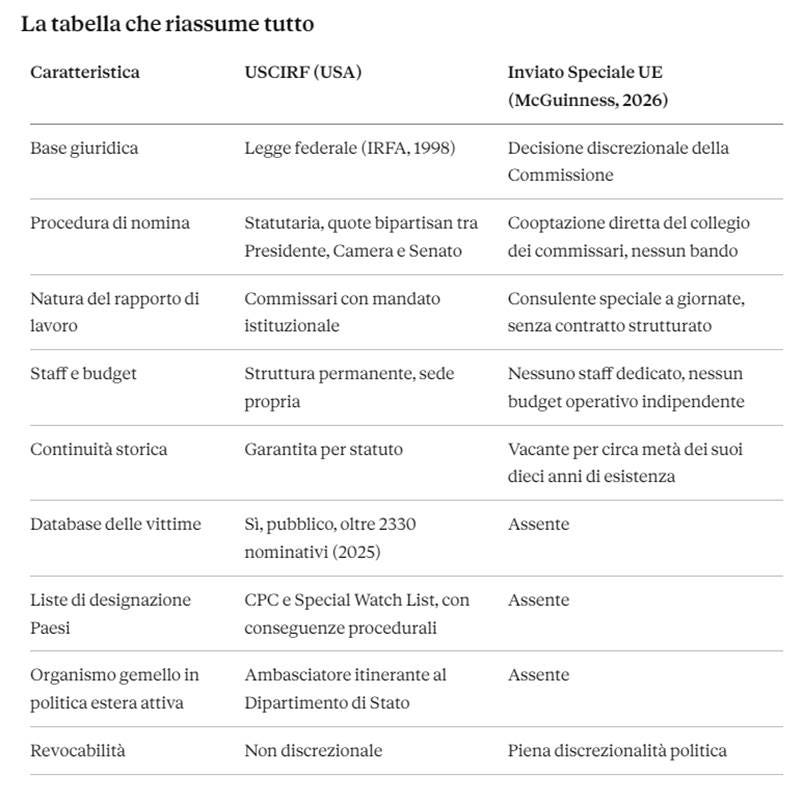
La
proposta: ECIRF, European Commission on International Religious Freedom
La strada
più realistica non è abolire la figura dell’Inviato Speciale, ma trasformarla
nel Presidente esecutivo di un’agenzia vera, dandole per la prima volta una
base statutaria e uno staff permanente invece di un mandato a chiamata
revocabile a discrezione della Commissione.
Base
giuridica. Regolamento del Parlamento europeo e del Consiglio, procedura
legislativa ordinaria, ancorato all’art. 21 TUE sui principi e obiettivi
dell’azione esterna dell’Unione, che include esplicitamente diritti umani e
libertà fondamentali. Questa base evita sovrapposizioni con la FRA di Vienna,
che ha mandato sui diritti fondamentali interni all’UE, non sull’azione
esterna.
Composizione.
Nove commissari con mandato fisso di quattro anni, rinnovabile una sola volta,
non revocabile se non per giusta causa accertata da un collegio indipendente:
tre designati dal Parlamento europeo in proporzione ai gruppi politici, tre dal
Consiglio a rotazione tra Stati membri, due dalla Commissione, uno dall’EEAS
con funzione di raccordo tecnico. È la non revocabilità discrezionale il punto
tecnico decisivo, quello che distingue un organismo statutario da un incarico
politico riassegnabile a piacimento come si è visto con McGuinness.
Funzioni.
1.
Rapporto annuale obbligatorio, con scadenza fissata per regolamento, trasmesso
automaticamente a Parlamento, Consiglio, Commissione e Alto Rappresentante.
2. Doppia
lista di monitoraggio, sul modello CPC/Special Watch List, con un obbligo
procedurale collegato: ogni accordo commerciale o di associazione con un Paese
in lista deve includere una valutazione d’impatto sulla libertà religiosa,
discussa in Commissione Affari Esteri del Parlamento europeo prima della
ratifica.
3. Potere
di audizione e visita, con diritto di richiedere audizioni pubbliche al
Parlamento europeo su casi specifici, e programma di missioni sul terreno
coordinato con le delegazioni UE.
4.
Funzione di allerta rapida, con canale diretto e tracciato verso l’Alto
Rappresentante per le crisi acute, distinto dal rapporto annuale.
Sede e
budget. Bruxelles, per prossimità con EEAS e Commissione. Stima 8-12 milioni di
euro annui, ampiamente coperti dai 22 milioni già stanziati storicamente
tramite lo strumento EIDHR per progetti di libertà religiosa, oggi gestiti a
progetto e privi di governance unitaria.
Le
obiezioni prevedibili, e come smontarle
“Duplica
la FRA.” Falso per costruzione: la FRA ha mandato sui diritti fondamentali
interni, l’ECIRF sarebbe vincolata esplicitamente all’azione esterna.
“È un
cavallo di Troia per un’agenda confessionale.” Da disinnescare con la
composizione pluralistica e con un mandato ancorato all’articolo 18 della
Dichiarazione universale dei diritti umani, quindi alla libertà religiosa in
generale, non alla sola persecuzione anticristiana.
È anche
l’argomento più efficace sul piano politico: un’agenzia percepita come a senso
unico perderebbe consenso trasversale ancora prima di nascere.
“Costa e
non serve.” I fondi ci sono già, sono i 22 milioni EIDHR spesi senza governance
unitaria. Il problema non è il denaro, è la continuità istituzionale,
esattamente il punto dimostrato dalla vacanza 2024-2026 e dal profilo a
giornate di McGuinness.
“Gli Stati
membri non cedono competenza.” L’ECIRF fa raccomandazioni, non decisioni
vincolanti su Stati terzi: il meccanismo è di reporting e allerta, non di
sanzione automatica. La politica estera sui diritti umani resta nella sostanza
intergovernativa.
Chiusura
Il
confronto non è tra un continente che non vuole difendere la libertà religiosa
e uno che lo fa. È tra un continente che ha scelto, trent’anni fa, di scriverlo
in una legge, e un continente che ancora oggi lo affida a una telefonata tra
colleghi di collegio, a giornate, senza ufficio.
Quando
scrivevo Vaticano Zero Day la domanda che davo per scontata era perché l’Europa
non avesse ancora colmato quel vuoto. Oggi la domanda è diversa, e più scomoda:
perché, avendo finalmente l’occasione di colmarlo, l’Europa ha scelto di farlo
nel modo più debole possibile. Chi risponde, oggi, ha una risposta fin troppo
precisa: nessuno, perché nessuno ha l’obbligo istituzionale di farlo.
English
version
Who
Answers? Europe Without a Watchdog on Religious Freedom
Why the
EU needs an agency, not just another name
Proposal
by Luigi Ricci, Analyst and Author, July 2, 2026
While
writing Vaticano Zero Day, I came across something that, once seen,
cannot be unseen. Unlike the United States, which has a permanent federal body
such as the U.S. Commission on International Religious Freedom, the European
Union has no structural, autonomous, binding mechanism for monitoring religious
persecution, and anti-Christian persecution in particular. European initiatives
remain episodic, entrusted to parliamentary resolutions with no operational
effect, or to diplomatic statements that produce no concrete consequences.
Even more
revealing is the absence of systemic conditionality. The Union negotiates
trade, energy, and strategic agreements with countries where persecution of
Christians is documented and growing, without that persecution ever becoming a
real constraint. India can record an exponential rise in anti-Christian
violence while deepening its strategic partnership with Brussels. China can
intensify the repression of unregistered Christian communities while the Union
keeps negotiating on trade, technology, and climate. Nigeria can ignore
thousands of Christians killed every year while Europe cooperates on gas
supplies and migration containment.
When I
wrote those lines, the absence I was describing was still, in a sense, a clean
absence: an institutional void, measurable, orphaned of a figure that no longer
even existed on paper. Since then, something has changed, though not in the way
one might have hoped. Europe has finally put a name back on that empty seat.
And it is precisely by looking at how it did so, through what procedure, with
what resources, with what degree of institutional seriousness, that one
understands the problem was never just the absence of a person. It was, and
still is, the absence of an architecture.
To
understand what Europe lacks, it helps to start with the institution that
actually has one.
The
model Europe doesn’t have
In 1998,
while Europe was still debating whether religious freedom belonged in treaties
or in encyclicals, the United States Congress passed the International
Religious Freedom Act and created a body that, nearly thirty years later,
remains without equal anywhere in the world: the United States Commission on
International Religious Freedom.
Not a
diplomatic office, not a temporary task force, but a federal agency created to
advise the executive branch and Congress on how to promote religious freedom
internationally. The same law simultaneously created a second position, the
Ambassador-at-Large for International Religious Freedom at the State
Department. In other words, the United States does not have a single instrument
on this issue, it has two, distinct and complementary: one independent of the
executive branch, reporting to Congress, and one embedded in active diplomacy,
negotiating directly with foreign governments.
The
Commission works with a method that has become a model in itself: it maps
violations, classifies them, names them. Its annual report, mandatory by law,
documents discrimination and persecution in every country in the world,
producing policy recommendations for the President, the Secretary of State, and
Congress. At the heart of the mechanism are two lists: Countries of Particular
Concern (CPC), for governments that commit or tolerate systematic, ongoing,
egregious violations, and the Special Watch List, for countries on a worsening
trajectory. In the 2025 report, the most severe tier includes Afghanistan,
Myanmar, China, Eritrea, India, Iran, Nigeria, North Korea, Pakistan, Saudi
Arabia, Tajikistan, Turkmenistan, and Vietnam. The designation is not symbolic,
it triggers by law a range of possible responses, from targeted sanctions to
diplomatic conditionality, ultimately decided by the State Department, but
through a process the law compels it to activate.
Alongside
country-level data, the Commission also names individuals. The FoRB Victims
List, a database of named cases updated annually, recorded over 2,330
documented victims in 2025, up from 2,200 the previous year, tied to 28
different governments or non-state actors. Three countries, China, Russia, and
Iran, account for 73 percent of documented cases. The report has also flagged a
relatively new phenomenon, transnational repression: Russia, China, Belarus,
and Turkey abusing the Interpol Red Notice system to target believers and
dissidents beyond their own borders.
This is
not an academic exercise. The Commission has had real impact on concrete cases,
not least its role in securing the release and safe exile of Asia Bibi, the
Pakistani Christian woman sentenced to death for blasphemy, a case also worked
on in parallel by the EU’s first Special Envoy, Ján Figeľ, proof that when
these mechanisms function, even in a lesser form, results follow.
But the
USCIRF’s function does not end with protecting the persecuted. It is, first and
foremost, a soft power instrument in the most classical sense political science
has given the term since Joseph Nye first theorized it: the ability to shape
others’ behavior not through coercion but through attraction, normative
legitimacy, and the production of a credible moral narrative. Saying “the
United States keeps a public, verifiable, bipartisan record of who persecutes
people for their faith” is worth more than a thousand diplomatic statements,
because it produces lasting reputational consequences: it enters trade
negotiations, bilateral relations, the way a third country calculates the
political cost of its own intolerance.
This is
exactly the function Europe lacks. Not so much, or not only, the capacity to
condemn, but the capacity to build stable, verifiable reputational capital over
time, capital that would make it as credible a moral interlocutor as the Holy
See is, in its own specific language, when it speaks of human rights without
armies or sanctions to threaten, but eleven centuries of institutional
continuity to guarantee its word.
The
void, in numbers
The
closest thing Europe has to a presence on this issue is the Special Envoy for
Freedom of Religion or Belief. But the position was created in 2016 not by
legislation, but by a political decision of the Commission, revocable and not
legally guaranteed to be filled.
The result
shows in the numbers: over the role’s roughly ten-year existence, the position
has been vacant for about half that time. Three consecutive years of inactivity
between 2019 and 2022. Then, after the two-year term of Frans van Daele,
another gap lasting 480 days, closed only on March 26, 2026, with the
appointment of Mairead McGuinness.
This is
not an administrative accident. It is the direct consequence of the absence of
a statutory basis: when a position depends on the political will of the moment,
its continuity depends on the political will of the moment. And the Special
Envoy’s recent history, laid out in sequence, is the best proof of this
structural fragility, more effective than any theoretical argument.
The
McGuinness Case, evidence for the prosecution more than for the defense
Mairead
McGuinness arrives with genuine credentials. A former journalist and television
presenter, a Fine Gael/EPP Member of the European Parliament from 2004 to 2020,
First Vice-President of the European Parliament from 2017 to 2020 with
responsibility precisely for interreligious dialogue under Article 17 TFEU, and
later European Commissioner for Financial Stability from 2020 to 2024.
COMECE
openly states it knows her well and has worked closely with her. The FoRB
parliamentary Intergroup welcomed the appointment as long overdue. On the
relational level, she is, without question, a figure already legitimized by the
circles that matter on this issue.
But it is
precisely here that the case becomes instructive rather than reassuring. Asked
directly by the Irish Times how she had been selected, the Commission answered
without hesitation: it is up to the College of Commissioners to identify a
special adviser for specific purposes, and there are no open calls for
applications. No comparative procedure, no public notice, no externally
verifiable criteria beyond the claim that the person is “highly qualified.” The
legal mechanism confirms the substance: McGuinness does not enter as an
official, nor as a contract manager, but under the category of “special
advisers,” who by administrative definition work on a short-term basis for a
very limited number of days per year, paid a daily rate calculated as a fraction
of a senior official’s base salary, day by day for missions actually carried
out, with no dedicated staff and no independent operating budget. Mission
expenses are reimbursed only when the Commission itself requests the travel.
The issue
is not the person. The issue is the circuit. A former Commissioner from the
2020-2024 College is called back by that same institutional body, co-opted
without any competition, on the basis of a prior relationship that COMECE
itself openly claims. It is a classic short-range revolving door, not toward
external lobbying but within the same institutional perimeter, with “we know
her well” standing in for a public process.
And what
is the track record of her work, more than three months after her appointment?
None exists, because none can yet exist in any verifiable form: no documented
public missions, no thematic statements on specific cases, no visible
initiative traceable to the mandate. It’s possible something is happening
behind the scenes, but publicly the operational profile remains silent, and it
will remain structurally weak as long as the role continues to be, in the words
of those who have investigated the matter, a voluntary assignment with no
office, no staff, and no budget of its own. The open question is whether the EU
is genuinely strengthening its defense of persecuted religious communities, or
simply repairing its own image after 480 days of vacancy.
The
table that sums it up
Feature
USCIRF
(USA)
EU
Special Envoy (McGuinness, 2026)
Legal
basis
Federal
law (IRFA, 1998)
Discretionary
decision of the Commission
Appointment
procedure
Statutory,
bipartisan quotas between President, House, and Senate
Direct
co-optation by the College of Commissioners, no open call
Nature of
the role
Commissioners
with an institutional mandate
Special
adviser paid by the day, no structured contract
Staff and
budget
Permanent
structure, dedicated office
No
dedicated staff, no independent operating budget
Historical
continuity
Guaranteed
by statute
Vacant for
roughly half of its ten-year existence
Victims
database
Yes,
public, over 2,330 named cases (2025)
None
Country
designation lists
CPC and
Special Watch List, with procedural consequences
None
Companion
body in active foreign policy
Ambassador-at-Large
at the State Department
None
Revocability
Not
discretionary
Fully
discretionary
The
Proposal: ECIRF, the European Commission on International Religious Freedom
The most
realistic path is not to abolish the Special Envoy role, but to transform it
into the executive chair of a real agency, giving it for the first time a
statutory basis and a permanent staff instead of an on-call mandate revocable
at the Commission’s discretion.
Legal
basis. A
Regulation of the European Parliament and the Council, under the ordinary
legislative procedure, grounded in Article 21 TEU on the principles and
objectives of the Union’s external action, which explicitly includes human
rights and fundamental freedoms. This basis avoids overlap with the
Vienna-based Fundamental Rights Agency (FRA), whose mandate covers fundamental
rights within the EU, not external action.
Composition. Nine commissioners with a fixed
four-year term, renewable once, not revocable except for just cause established
by an independent panel: three appointed by the European Parliament in
proportion to political groups, three by the Council on a rotating basis among
Member States, two by the Commission, and one by the EEAS in a technical
liaison role. Non-discretionary revocability is the decisive technical point,
the one that distinguishes a statutory body from a political appointment
reassignable at will, as seen with McGuinness.
Functions.
- A mandatory annual report,
with a deadline fixed by regulation, automatically transmitted to
Parliament, the Council, the Commission, and the High Representative.
- A two-tier monitoring list,
modeled on the CPC/Special Watch List system, tied to a procedural
obligation: any trade or association agreement with a listed country must
include a religious freedom impact assessment, discussed in the European
Parliament’s Foreign Affairs Committee before ratification.
- Hearing and visit powers,
including the right to request public hearings in the European Parliament
on specific cases, and a program of field missions coordinated with EU
delegations.
- An early-warning function,
with a direct, traceable channel to the High Representative for acute
crises, separate from the annual report.
Headquarters
and budget. Brussels,
for proximity to the EEAS and the Commission. Estimated at €8-12 million
annually, largely covered by the €22 million historically allocated through the
EIDHR instrument for religious freedom projects, currently managed project by
project with no unified governance.
Predictable
objections, and how to counter them
“It
duplicates the FRA.”
False by design: the FRA’s mandate covers internal fundamental rights, while
the ECIRF would be explicitly bound to external action.
“It’s a
Trojan horse for a confessional agenda.” This can be defused through pluralistic composition
and a mandate anchored to Article 18 of the Universal Declaration of Human
Rights, covering religious freedom in general, not anti-Christian persecution
alone. This is also the most effective political argument: an agency perceived
as one-sided would lose cross-party support before it even came into existence.
“It
costs money and isn’t needed.”
The funds already exist, the €22 million in EIDHR spending without unified
governance. The problem is not money, it’s institutional continuity, exactly
the point demonstrated by the 2024-2026 vacancy and by McGuinness’s day-rate
profile.
“Member
states won’t cede competence.”
The ECIRF issues recommendations, not binding decisions on third countries: the
mechanism is one of reporting and early warning, not automatic sanction.
Foreign policy on human rights remains, in substance, intergovernmental.
Closing
The
contrast here is not between a continent that refuses to defend religious
freedom and one that does. It is between a continent that chose, thirty years
ago, to write it into law, and a continent that, to this day, still entrusts it
to a phone call between former colleagues on the College, paid by the day, with
no office. When I was writing Vaticano Zero Day, the question I took for
granted was why Europe had not yet filled that void. Today the question is
different, and more uncomfortable: why, having finally had the chance to fill
it, Europe chose to do so in the weakest way possible. Who answers, today, has
an answer that is far too precise: no one, because no one is institutionally
obligated to.


Commenti
Posta un commento